

Hello, I am Jim Husseini, owner and Certified Master Inspector at Pinnacle Inspection Services. Throughout my years inspecting residential properties across Northeast Ohio—from the historic neighborhoods of Cleveland and Lakewood to established communities in Akron and Canton—I routinely encounter older siding materials that raise immediate questions for buyers and homeowners. One of the most prevalent is asbestos-cement shingle siding, often known by its primary trade name, Transite. Engineered for extreme durability and fire resistance, this material was installed on millions of homes built between the 1920s and 1970s. Understanding how to visually spot Transite, evaluate its condition, and manage it safely is critical when purchasing or renovating an older home in our region.
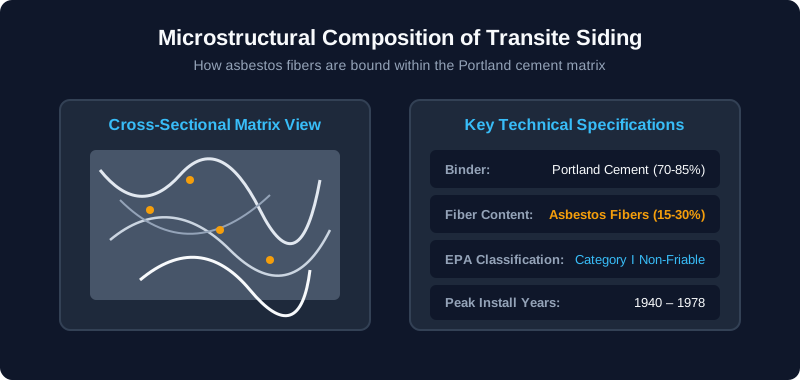
- Engineered Composition: Transite siding consists of Portland cement reinforced with approximately 12% to 50% asbestos fibers, creating a dense, highly durable composite material.
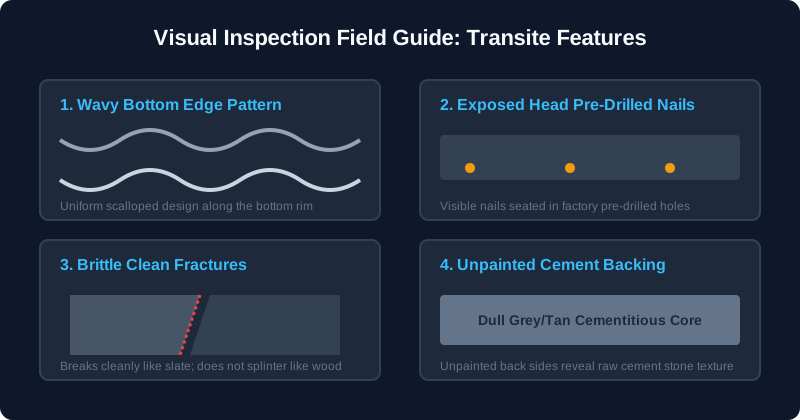
- Distinctive Visual Markers: Standard features include a rigid 12-inch by 24-inch profile, distinct wavy or scalloped bottom edges, textured faux-wood grain, and exposed nail heads along the bottom overlap.
- High Prevalence in Northeast Ohio: Very common on mid-century Cape Cods, Craftsman bungalows, and ranch homes, often direct-attached or encapsulated underneath modern vinyl siding.
- Low Risk When Intact: Transite is a non-friable material, meaning the asbestos fibers are tightly locked within the cement matrix and cannot easily become airborne unless scraped, drilled, cut, or pressure washed.
- Professional Handling Required: If left unmanaged, damaged shingles require careful sealing, professional encapsulation, or licensed abatement following EPA and Ohio EPA protocols.
What is Transite Siding? Understanding the Material
Transite was originally developed by Johns-Manville in the early 20th century as a revolutionary exterior cladding solution. By combining hydraulic Portland cement with mineral asbestos fibers under heavy hydraulic pressure, manufacturers produced a lightweight, fireproof, rot-proof, and insect-resistant wall shingle. Its popularity soared throughout Northeast Ohio during the post-WWII housing boom due to its exceptional resistance to harsh winter freeze-thaw cycles and damp Midwestern springs.
The asbestos content in these rigid cement panels typically ranges between 15% and 40%, primarily using chrysotile (white asbestos) and occasionally amosite (brown asbestos). Because the fibers are completely encased in solid concrete, the material is categorized by environmental authorities as Category I Non-Friable Asbestos-Containing Material (ACM). In practical terms, intact Transite siding does not release dangerous airborne fibers during normal daily exposure.
Key Visual and Physical Identifiers
When conducting home inspections throughout Cuyahoga, Summit, and Medina counties, I rely on a combination of visual cues, dimensional checks, and material evaluation to recognize Transite siding. You do not need to pull off shingles or damage the exterior to make a strong preliminary identification.
1. Dimensional Profile and Standard Sizes
Unlike continuous horizontal lap siding made of wood or vinyl, Transite siding was manufactured as individual rectangular tiles or shingles. The vast majority measure 12 inches high by 24 inches wide, with a thickness of roughly 1/8 to 3/16 of an inch. They are significantly thinner than traditional cedar shake shingles but far harder and more rigid than wood or vinyl siding.
2. Edge Designs and Surface Textures
Transite shingles were manufactured in several distinct styles designed to mimic traditional wood shaking. The two most common visual profiles include:
- Wavy or Scalloped Bottom Edge: The bottom exposed edge of each shingle features a repeating, uniform wavy curve pattern.
- Straight Edge with Vertical Striations: The bottom edge is clean and straight, but the face features heavy vertical grooves molded directly into the cement to emulate realistic cedar grain.
- Smooth Stucco Texture: A flat, matte, slightly pitted finish common on mid-century modern and ranch-style homes.
3. Exposed Fastener Placement
Because asbestos-cement shingles are extremely hard and brittle, installers could not drive nails directly through the face without shattering the shingle. Manufacturers pre-drilled small nail holes along the bottom exposed edge of each piece. As a result, small, exposed nail heads are clearly visible along the bottom rim of every installed Transite shingle, holding the overlapping bottom edge flush against the wall.
Comparing Transite Siding to Other Materials
Homeowners often confuse Transite with modern fiber-cement siding (such as HardiePlank), slate shingles, or painted wood shingles. The comparison table below highlights key differences to assist in identification:
Hidden Encapsulation: The “Layer Cake” Siding Trend
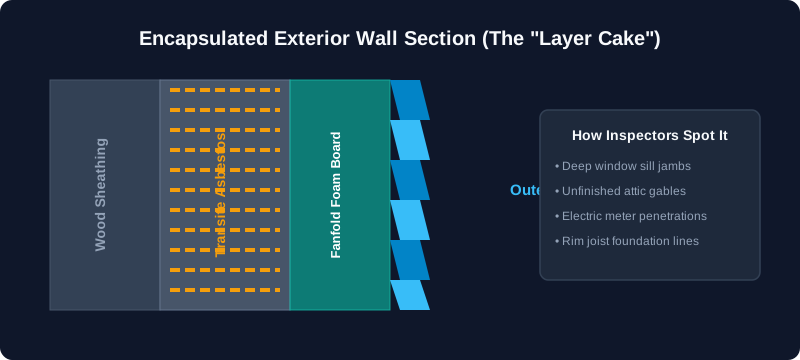
In Northeast Ohio, it is extremely common to inspect a home clad in modern vinyl siding, only to discover original Transite asbestos siding hidden directly beneath it. During the 1980s, 90s, and 2000s, siding contractors frequently recommended re-siding over existing Transite rather than paying for expensive abatement and disposal.
Contractors typically nailed wood furring strips or installed 3/8-inch fanfold foam insulation directly over the asbestos shingles, then nailed new vinyl siding into those strips. While this is an accepted encapsulation strategy when executed correctly, it can create hidden hazards if future homeowners decide to drill into exterior walls, install new windows, or cut openings for ventilation fans without realizing what lies underneath.
Safety Protocols and Best Practices for Homeowners
Finding Transite siding on a house you own—or plan to buy—is not a reason to panic. Unlike friable pipe insulation or sprayed-on acoustic ceiling plaster, asbestos cement siding binds its mineral fibers in solid concrete. When intact and un-disturbed, it presents an extremely low risk of fiber release into the surrounding air.
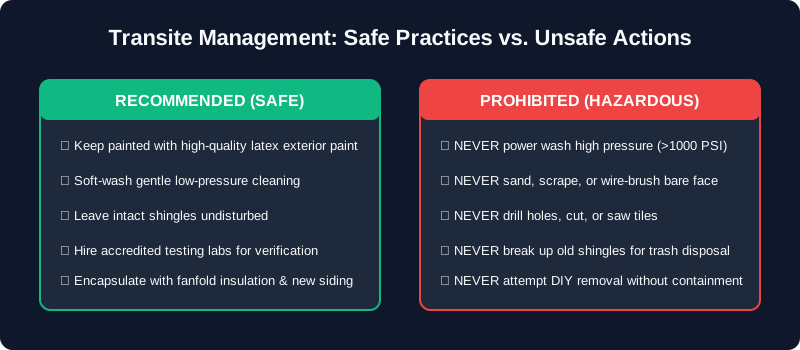
However, safety depends entirely on how the material is handled. Homeowners must adhere to strict safety guidelines to ensure the siding remains safe and intact:
Maintenance and Painting
The single best way to preserve Transite siding is to keep it painted. A fresh coat of high-grade 100% acrylic latex exterior paint binds the surface layer, sealing in any micro-fibers and preventing environmental erosion. Before painting, the siding should be cleaned gently using low-pressure garden hoses and mild detergents—never use high-pressure power washers, as intense water streams shatter the matrix and disperse microscopic fibers into the surrounding air and soil.
Testing and Professional Removal
While visual markers are strong indicators, federal standards state that positive asbestos identification can only be legally confirmed through laboratory analysis using Polarized Light Microscopy (PLM). If you plan to perform major structural renovations that require removing wall sections, consult an EPA-certified lead and asbestos inspector. In Ohio, licensed asbestos abatement contractors handle safe removal, containment, transport, and disposal at authorized facilities.
Is asbestos siding dangerous if left alone on my home?
No. Transite asbestos siding is classified as non-friable, meaning the mineral fibers are embedded within solid Portland cement. As long as the shingles remain unbroken, unpainted, and un-disturbed, they release virtually no airborne fibers and present an extremely low health risk to residents.
Can I cover asbestos siding with vinyl siding?
Yes, encapsulating asbestos siding behind modern vinyl siding is a widely recognized and legal practice in Northeast Ohio. Contractors install wood furring strips or foam board insulation over the Transite, creating a protective barrier and allowing new siding to be securely anchored without removing the underlying material.
How do home inspectors in Northeast Ohio evaluate asbestos siding?
During a home inspection, certified inspectors visually assess the siding’s overall structural condition, looking for signs of cracking, mechanical damage, delamination, or improper modification. We document its presence, explain proper maintenance protocols, and advise clients on safe ownership practices without performing destructive testing.
Planning to buy or sell an older home in Northeast Ohio? Partner with an experienced inspector who understands regional architectural details and historic building materials. Contact Jim Husseini at Pinnacle Inspection Services today to schedule a comprehensive, unbiased home inspection for your peace of mind.