

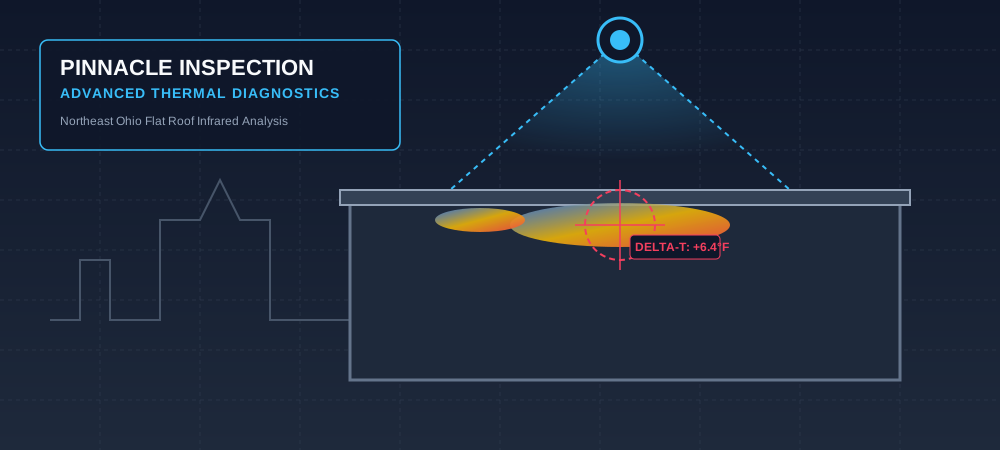
Flat roofing systems on commercial buildings and modern residential properties throughout Northeast Ohio face some of the harshest environmental stresses in the country. From brutal lake-effect winter freezes to intense summer heat waves, the constant expansion and contraction breaks down roofing membranes long before their expected lifespan. Traditional visual inspections frequently fail to locate the true origin of a leak, leading property owners to waste thousands on temporary patches or unnecessary full roof replacements. Thermal imaging (infrared thermography) changes the game entirely by allowing inspectors to see beneath the membrane and pinpoint trapped moisture with surgical precision.
- Non-Destructive Moisture Detection: Infrared cameras identify trapped water beneath the roofing membrane without puncturing or damaging the surface layer.
- Substantial Cost Savings: Locating precise areas of wet insulation allows for targeted repairs, saving tens of thousands compared to total roof replacement.
- Tailored for Northeast Ohio Climate: Captures thermal capacitance differences caused by severe freeze-thaw cycles unique to Greater Cleveland and surrounding areas.
- Origin Traceability: Water rarely drips inside directly below where it enters the roof surface; thermal imaging maps the entire subterranean moisture pathway.
- Verifiable Reporting: Provides indisputable visual data required for commercial real estate transactions, insurance claims, and warranty verifications.
The Unique Vulnerability of Flat Roofs in Northeast Ohio
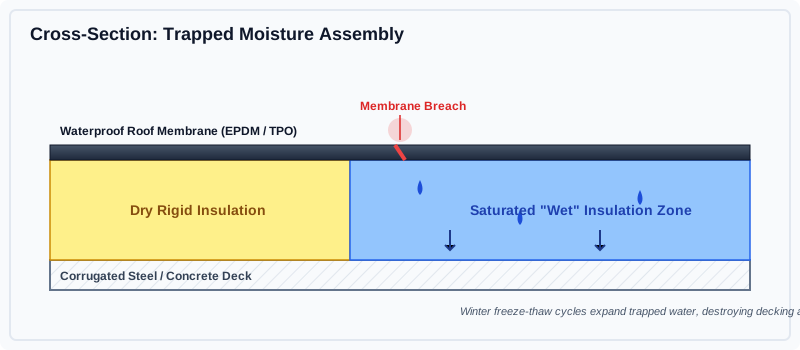
Unlike sloped asphalt shingle roofs that naturally shed water using gravity, flat roofs—technically low-slope roofs—rely on an intact, continuous waterproof membrane to keep precipitation out. In Northeast Ohio, properties are subjected to extreme weather swings, including heavy snow loads, rapid freeze-thaw cycles, and relentless wind-driven rain from Lake Erie. When water finds even a microscopic seam failure or puncture in EPDM (rubber), TPO, or modified bitumen membranes, it trickles inward and saturates the rigid insulation boards underneath.
Once moisture enters the insulation layer beneath a flat roof membrane, it becomes trapped. During winter months, this trapped water freezes and expands, causing “tenting,” membrane delamination, and accelerated structural deterioration. Visually, the roof surface may look completely healthy, while underneath, board feet of insulation are decaying, losing thermal efficiency, and rotting the structural roof deck.
How Thermal Imaging Works: The Science of Thermal Capacitance
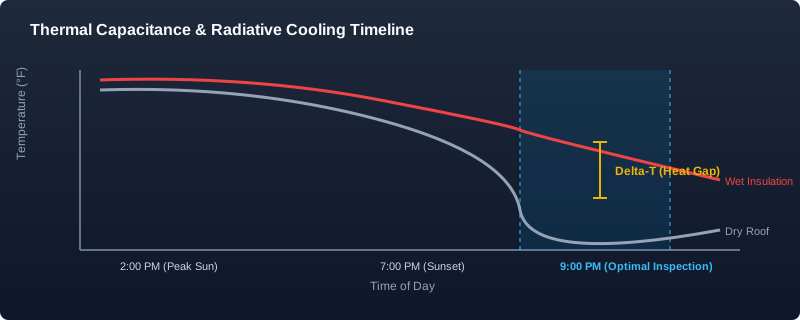
Thermal imaging cameras do not see moisture directly; rather, they detect minute surface temperature differences (expressed as Delta-T) emitted as long-wave infrared radiation. The physics relies on a property known as thermal capacitance—the ability of a material to store heat energy over time.
Dry roofing materials and dry insulation have very low thermal capacitance. They heat up rapidly under direct sunlight during the daytime and cool down extremely fast once the sun sets. Conversely, water has an exceptionally high thermal capacitance. Wet insulation absorbs massive amounts of heat during the daylight hours and retains that heat energy far longer into the evening than surrounding dry areas.
The Radiative Cooling Inspection Window
To perform a successful infrared flat roof survey, timing is critical. As twilight approaches and solar radiation ceases, the roof enters a period of radiative cooling. The dry sections of the roof clear out stored heat almost immediately, dropping sharply in surface temperature. The wet, saturated pockets of insulation retain their heat and continue radiating thermal energy upward.
When viewed through a high-resolution thermal imaging camera, these wet pockets glow brightly as warm “hot spots” (yellow, orange, red, or white depending on the color palette selected), while the dry, healthy roof displays as cool, dark shades of blue or purple.
Visual Inspections vs. Thermal Imaging: A Direct Comparison
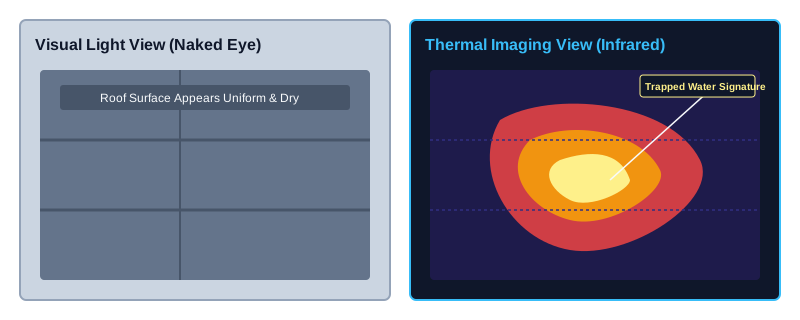
When relying strictly on standard human vision, detecting flat roof leaks is largely guesswork. Water takes the path of least resistance. It can enter through a tiny seam tear on the north side of a commercial building, flow 40 feet horizontally along a sloped steel structural fluting deck, and finally drip through an interior ceiling light fixture on the south side. Patching the roof directly above the interior leak site accomplishes nothing because the true entry point remains exposed.
In contrast, thermal imaging provides clear, quantitative visual contrast between dry and saturated building assemblies. The comparison below illustrates what an inspector sees with the naked eye versus what an infrared sensor unveils.
The Pinnacle Inspection Four-Step Thermal Protocol
At Pinnacle Inspection Services, we follow a rigorous, scientific methodology to ensure every thermal survey delivers accurate, actionable diagnostic intelligence. Thermal imaging is a powerful tool, but it must be paired with physical moisture verification to eliminate false positives caused by HVAC discharge, solar reflection, or varying insulation thicknesses.
Step 1: Environmental Planning & Pre-Scan Conditions
We monitor local Northeast Ohio microclimates to select the ideal night for scanning. Optimal conditions require a high daytime solar load followed by a rapid temperature drop after sunset, low wind speeds (below 15 mph), and a dry roof surface clear of standing surface water.
Step 2: Infrared Aerial & Surface Thermography
Using high-resolution FLIR infrared cameras with high thermal sensitivity (NETD <40 mK), our certified inspectors systematically scan the entire roof deck during the peak radiative cooling window. We adjust emissivity settings specifically for EPDM, TPO, PVC, or gravel-surfaced built-up systems.
Step 3: Direct Non-Destructive Moisture Verification
Once thermal anomalies are identified, we immediately cross-verify the findings on-site. Using non-destructive electronic moisture impedance meters or pinless capacitance probes, we measure actual moisture content levels inside the substrate to confirm whether the thermal anomaly is indeed water saturation.
Step 4: CAD Mapping & Repair Boundary Marking
We paint precise boundary lines directly onto the roof surface defining the perimeter of wet insulation. We then translate this visual data into detailed CAD or PDF mapping reports, allowing roofing contractors to perform surgical, highly localized repairs rather than selling you an unnecessary full roof teardown.

Financial Benefits: Preserve Capital and Prevent Premature Replacement
Commercial roof replacements in Northeast Ohio typically cost between $10 and $22 per square foot depending on materials, tear-off requirements, and structural repairs. For a 25,000-square-foot facility, replacing a flat roof can quickly balloon into a $300,000+ capital expenditure.
In many cases, thermal imaging reveals that only 5% to 15% of the total insulation board area has suffered moisture intrusion. Instead of discarding an entire roofing assembly, property owners can perform a targeted wet-insulation replacement and membrane restore for a fraction of the cost. Incorporating annual infrared thermography into your preventative maintenance schedule extends roof service life by 10 to 15 years, lowers building heating and cooling costs, and provides complete documentation for warranty claims.
Frequently Asked Questions
How long after a rainstorm should a thermal roof inspection be conducted?
An infrared flat roof inspection should ideally be conducted 24 to 48 hours after a rainstorm. The roof surface membrane must be completely dry so that standing water or puddles do not skew thermal readings through evaporative cooling, while allowing sufficient time for water to saturate the insulation layers below.
Can a thermal camera detect leaks through all flat roof types?
Thermal imaging is exceptionally effective on smooth EPDM, TPO, PVC, and modified bitumen single-ply systems. While it can also be used on heavily graveled Built-Up Roofs (BUR), ballast pavers or thick gravel can reduce thermal resolution, requiring enhanced equipment and specialized moisture meters for verification.
Is a thermal camera alone enough to confirm a leak?
No. Thermal imaging detects surface temperature variations, not water molecules directly. Thermal anomalies can sometimes be caused by interior HVAC ductwork, reflective roof coatings, or variations in original construction. A professional inspector must always cross-check thermal signatures using physical, non-destructive moisture meters to definitively verify wet insulation.
Protect Your Investment with Pinnacle Inspection Services
Don’t let hidden flat roof moisture destroy your structural decking or force an premature replacement. Led by Jim Husseini B.S., C.P.I., Pinnacle Inspection Services brings industry-leading infrared technology and certified expertise to commercial property owners, buyers, and facility managers across Northeast Ohio. Contact Pinnacle Inspection Services today to schedule a comprehensive infrared flat roof survey and safeguard your building against Cleveland’s toughest weather.