

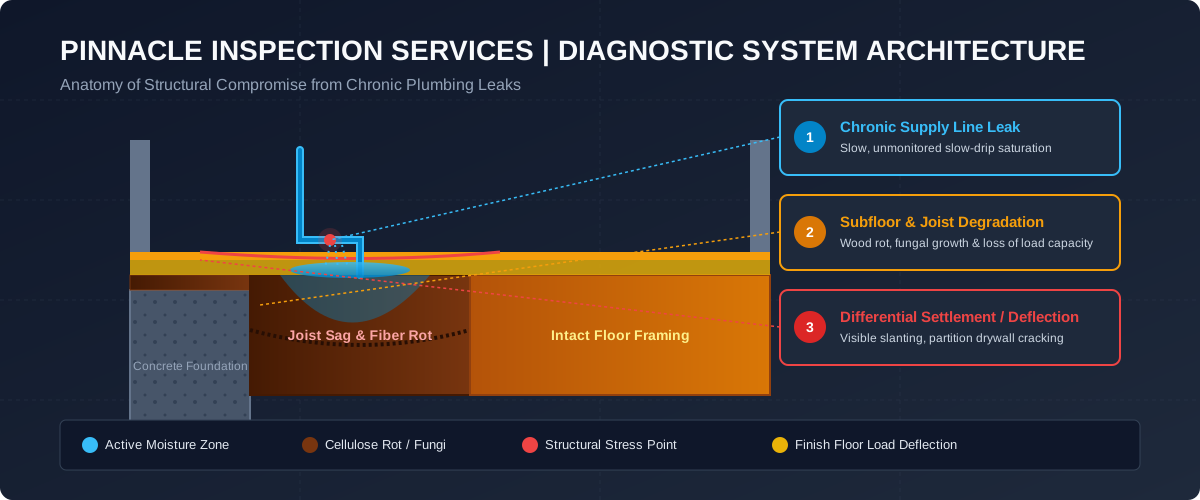
When most homeowners think of plumbing disasters, they imagine a burst pipe sending a torrent of water rushing through the living room ceiling. However, as a Certified Professional Inspector evaluating homes across Northeast Ohio—from historic Cleveland Heights colonials to modern developments in Akron and Canton—I can tell you that the most destructive plumbing issues are rarely sudden or dramatic. The real threat comes from chronic, slow, unseen leaks that silently saturates load-bearing framing over months or even years. By the time visible signs appear inside the living area, the underlying structural integrity of the home may already be severely compromised.
- Slow Leaks Are More Destructive Than Floods: High-volume pipe bursts get noticed and dried immediately, whereas slow pinhole leaks nourish wood-destroying fungi that systematically eat away at load-bearing framing over time.
- Subtle Interior Warnings: Diagonal drywall cracks above door frames, springy or unlevel floors, and sticking interior doors are frequently symptoms of framing deflection caused by moisture, not just natural house settling.
- Subfloor and Joist Vulnerability: Standard dimensional lumber and engineered I-joists lose structural load capacity when moisture content remains consistently above 20%.
- Northeast Ohio Climate Amplification: Our regional freeze-thaw cycles and high humidity accelerate cellulose decay in subterranean framing, basements, and crawlspaces.
- Advanced Diagnostics Save Tens of Thousands: Non-invasive tools like thermal imaging cameras and high-frequency moisture meters allow us to pinpoint active concealed leaks before complete structural framing failure occurs.
Understanding the Mechanics: How Water Destroys Structural Wood
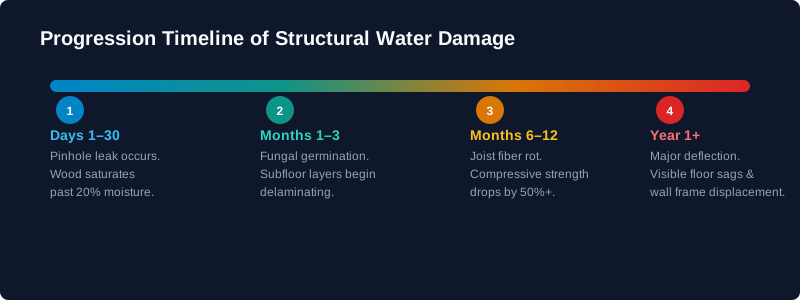
To understand how a simple plumbing leak threatens an entire home, you must understand the organic nature of construction lumber. Floor joists, sill plates, subflooring, and wall studs are made of cellulose material. Dry wood framing used in modern and historic home construction typically maintains a healthy equilibrium moisture content between 8% and 12%. When a supply line, drain pipe, or shower pan develops a continuous slow leak, the moisture content of adjacent framing spikes dramatically.
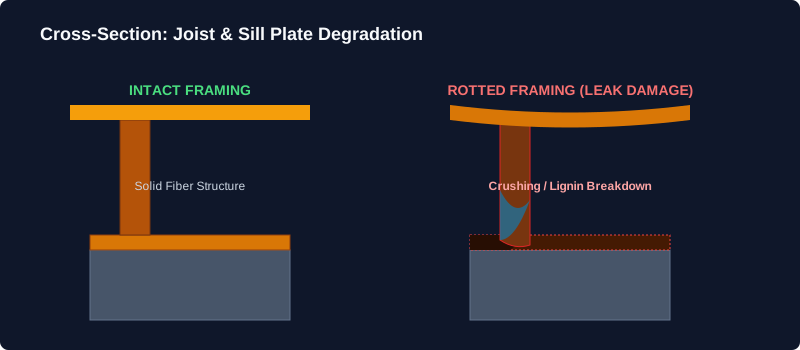
Once wood moisture content surpasses 20%, it creates an ideal ecosystem for wood-decay fungi (such as Serpula lacrymans or wet rot spores). These organisms break down the lignin and cellulose matrix—the natural polymeric materials that give wood its immense tensile and compressive strength. As the wood rots, it loses its ability to carry design loads. Under the weight of furniture, appliances, and foot traffic, the compromised framing begins to compress, warp, twist, and sag.
Top Interior Signs of Hidden Plumbing-Induced Structural Damage
Homeowners often mistake structural warning signs for simple age-related cosmetic defects. While older homes in the Cleveland area naturally experience mild settlement over a century, localized differential movement is a classic flag for chronic plumbing leaks.
1. Floor Deflection and Slope Variations
If you notice a sudden dip in your floor near a bathroom, kitchen, or laundry room, structural wood decay is a primary suspect. Under normal conditions, floor joists span from wall to beam seamlessly. When a leak beneath a shower drain or toilet wax ring saturates the subfloor and joist tops, the wood softens. The joists begin to bend under load, creating a bowl or slope in the finished floor above.
2. Diagonal Drywall Cracks Above Door and Window Frames
When the floor framing below a wall sags, the entire wall partition drops along with it. Drywall is extremely rigid and brittle; it cannot flex under structural movement. As a result, shearing stresses concentrate at weak points, typically originating from the top corners of door frames and windows. Cracks that run diagonally (at a 45-degree angle) or step upward are key indicators of underlying framing failure.
3. Sticking, Misaligned, or Self-Opening Doors
Are you finding that a second-floor bathroom door suddenly refuses to latch, or rubs heavily against the top of the jamb? When floor joists beneath internal partition walls soften due to plumbing moisture, door frames rack—turning from true rectangles into parallelograms. This shifting alters door clearance overnight.
4. Cupped, Buckled, or Discolored Flooring
Hardwood flooring reacts dramatically to subterranean moisture. Water migrating upward through rotting subfloor plywood forces hardwood boards to cup (edges rising higher than the center) or buckle entirely off the subfloor. Vinyl or tile floors may present as loose, cracked, or squishy underfoot, indicating that the subfloor beneath has turned to mush.

Subfloor and Foundation Inspection Findings: What Lies Below
When conducting thorough home inspections across Northeast Ohio, the most critical structural insights are uncovered in the basement, crawlspace, or utility access zones directly below bathrooms and kitchens. Unfinished basements offer an ideal vantage point to inspect the structural skeleton of the home.
Here are the critical conditions we routinely look for during a professional structural assessment:
Sill Plate & Rim Joist Decay
The sill plate sits directly on top of your concrete or masonry foundation wall, forming the foundation anchor for your entire wooden floor structure. When supply pipes running through exterior rim joist cavities leak slowly, water pools on top of the sill plate. Over time, the sill plate turns soft and crumbles (dry rot / wet rot condition). When the sill plate disintegrates, the floor joists resting on it sink downward, pulling the exterior wall inward and leading to severe masonry cracking or exterior siding distortion.
Subfloor Delamination and Punch-Through
Modern homes use engineered subflooring such as OSB (Oriented Strand Board) or plywood. When exposed to persistent plumbing moisture, OSB swells, loses its internal adhesive bonding, and flakes apart like soggy cardboard. In advanced cases of toilet flange leaks, the subfloor rots away entirely, leaving the toilet resting precariously on nothing more than the thin vinyl surface layer or rusted iron drain flange.
Diagnostic Equipment: How Pinnacle Inspection Services Detects Hidden Leaks
Visual clues tell only half the story. As a home inspector, relying purely on the naked eye can leave hidden structural decay undetected until major failure occurs. At Pinnacle Inspection Services, we utilize state-of-the-art diagnostic technology to locate hidden plumbing leaks and evaluate framing health non-invasively.
Thermal Imaging (Infrared Scanning)
Water evaporating from leaking pipes or saturated wood creates a distinct thermal signature. Infrared cameras detect these subtle temperature differentials behind drywall, plaster, tile, and under subfloors. An active pinhole leak behind a tiled shower wall appears as a distinct cool pattern on our thermal imaging display long before moisture stains or mold become visible on the surface.
Advanced Moisture Meters (Pinless and Pin-Type)
When thermal anomalies are identified, we use high-frequency pinless moisture meters to scan deep beneath surfaces without damaging finishes. If elevated moisture levels are detected in structural members, calibrated pin-type meters measure the exact percentage of moisture content inside the core of the wood joist or sill plate, verifying whether conditions promote active fungal decay.

Remediation Strategies: Fixing the Structure and Stopping the Water
When chronic plumbing leaks cause structural damage, simply calling a plumber to stop the leak is only step one. Correcting the damage requires a coordinated approach:
- Eliminate the Source: Repair or replace corroded piping, failing shower pans, deteriorated drain lines, or worn toilet wax rings immediately.
- Structural Drying: Professional-grade dehumidifiers and air movers must reduce framing timber moisture content below 15% before any structural repairs or wall closures begin.
- Slicing or Sistering Joists: If structural joists have experienced minor localized rot, licensed contractors can “sister” them by sandwiching healthy dimensional lumber or engineered steel plates alongside the damaged joist, securing them with structural through-bolts.
- Full Member Replacement: If wood rot has completely compromised the bearing ends of floor joists or sill plates, temporary hydraulic shoring posts must be installed to support floor loads while the rotted framing members are cut away and fully replaced.
How do I know if a ceiling crack is cosmetic or structural?
Cosmetic cracks are usually hairline thin, follow straight drywall tape seams, and result from natural humidity fluctuations. Structural cracks from plumbing leaks are typically wider than 1/8 inch, run diagonally from door or window corners, coincide with sagging floors above, or show active water discoloration along the fracture path.
Can a minor pinhole plumbing leak really collapse a floor?
Yes. A steady copper pipe pinhole leak dripping just a few ounces of water per hour will completely saturate surrounding wood subflooring and framing timber over 6 to 12 months. This sustained moisture fosters wood-rotting fungi, which can reduce wood’s structural load capacity by up to 75%, eventually leading to localized floor failure under normal weight.
Will homeowner’s insurance cover structural damage caused by long-term leaks?
Standard home insurance policies typically cover sudden and accidental water discharges (such as a burst supply line). However, structural rot resulting from chronic, long-term, unaddressed plumbing leaks or lack of maintenance is frequently excluded from coverage. Early detection through regular inspections is essential to protect your investment.
Protect Your Northeast Ohio Home with Pinnacle Inspection Services
Whether you are buying a historic home in Shaker Heights, evaluating a property in Akron, or maintaining your long-term residence, hidden plumbing leaks pose a severe risk to your home’s structural integrity. At Pinnacle Inspection Services, Jim Husseini B.S., C.P.I., brings deep technical expertise and advanced non-invasive technology to every property evaluation. Contact Pinnacle Inspection Services today to schedule your comprehensive structural and moisture assessment before minor leaks turn into structural repairs.