

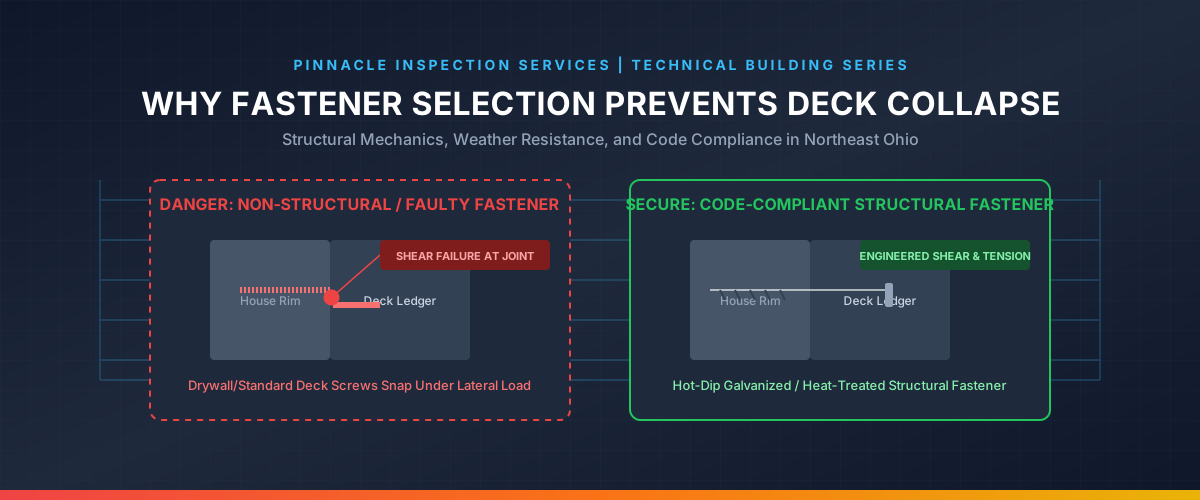
Every year, thousands of residential decks across North America suffer catastrophic structural failures. In Northeast Ohio—where deck structures endure heavy winter snow loads, continuous freeze-thaw thermal cycling, and humid summer conditions—the margin for structural error is zero. As a Certified Professional Inspector running Pinnacle Inspection Services, I routinely evaluate deck framing systems across Cleveland, Akron, Canton, and the surrounding areas. The single most alarming issue I encounter is not rotted timber or missing posts, but the silent, invisible danger of improper fastener selection. Understanding why using the wrong screw or nail can cause a deck to suddenly collapse is vital for every homeowner and buyer in our region.
- Shear vs. Tension Dynamics: Standard deck and drywall screws possess high tensile strength but lack shear resistance, causing them to snap brittlely under vertical load.
- The Ledger Board Hazard: Over 80% of deck collapses occur at the ledger connection due to missing structural lag screws, improper flashing, or unapproved fasteners.
- Chemical Corrosion Mechanisms: Modern ACQ pressure-treated lumber leaches copper into metal, rapidly eating through non-corrosion-resistant fasteners.
- Northeast Ohio Climate Strain: Lake-effect snow loads exceeding 30–40 pounds per square foot place intense, sustained mechanical stress on critical framing connections.
- Code Compliance Matters: The International Residential Code (IRC) Section R507 strictly mandates structural screws, hot-dip galvanized hardware, or stainless steel fasteners.
The Physics of Fasteners: Shear Strength vs. Tensile Strength
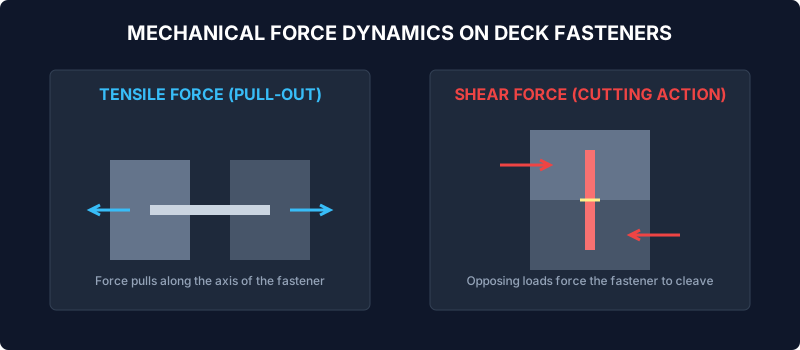
To understand why decks collapse, one must first grasp the physical forces exerted on fasteners. Fasteners in deck construction are subjected to two primary mechanical forces: shear force and tensile force.
Tensile force acts parallel to the fastener, attempting to pull it out end-to-end (such as the tension generated when people lean heavily against a deck guardrail). Shear force, on the other hand, acts perpendicular to the fastener—effectively trying to cleave the screw or nail in two. This is the exact force exerted by the weight of joists, decking, heavy snow, and occupants pulling downward against the house frame.
Many homeowners and well-meaning DIYers assume that because a screw is made of hardened steel, it can be used anywhere on a deck. Standard deck screws and drywall screws are heat-treated to make them extremely hard so their driver heads do not strip easily. However, this hardness renders them brittle. When subjected to horizontal shear forces generated by a heavily loaded deck, brittle screws do not bend; they snap instantly without warning.
Conversely, structural nails (such as 10d or 16d common hot-dip galvanized nails used in joist hangers) are made from ductile steel. While they may bend under excessive shear load, they rarely snap instantly, maintaining structural integrity long enough to prevent sudden total collapse. Modern structural screws—specifically engineered with high shear capacities—are heat-treated using advanced metallurgy to offer the best of both worlds: extreme tensile holding power combined with high shear resistance and flexibility.
The Ledger Connection: Ground Zero for Deck Collapses
Statistical studies by the North American Deck and Railing Association (NADRA) indicate that approximately 80% to 90% of deck collapses occur as a direct result of the ledger board detaching from the house rim joist. The ledger board is the primary structural beam that attaches the deck directly to your home’s framing, supporting roughly half of the entire deck weight.
Historically, builders attached ledger boards using standard framing nails or simple drywall screws. Over time, as dynamic loads (people walking, dancing, snow accumulating) push down and pull away from the building, these inferior fasteners rust, shear, or pull completely out of the house rim board.
Current Building Code Requirements (IRC R507)
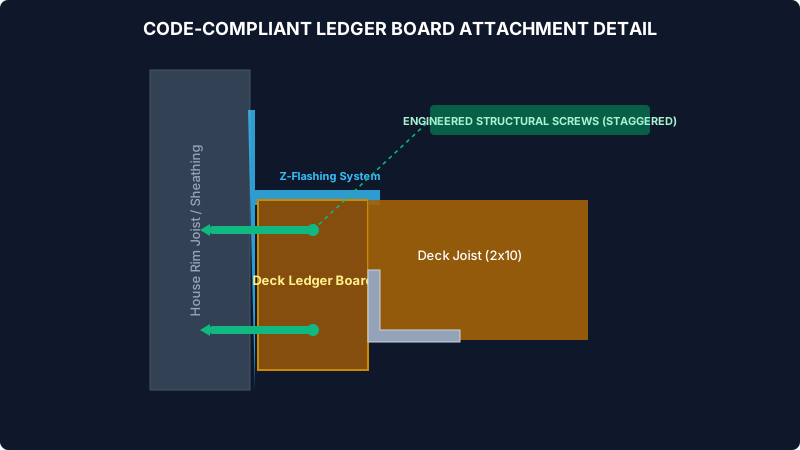
Modern building codes, including the Residential Code of Ohio based on the IRC, strictly prohibit attaching ledger boards with nails or drywall screws. Section R507 specifies the exact fastening patterns required for ledger attachment:
- Fastener Specifications: Minimum 1/2-inch hot-dip galvanized lag screws or approved engineered structural wood screws (such as FastenMaster LedgerLOK or Simpson Strong-Tie SDWS series).
- Staggered Fastening Pattern: Fasteners must be installed in a high-low staggered pattern along the length of the ledger board to prevent splitting the lumber along its grain lines.
- Sizing and Penetration: Screws must extend fully through the house rim board by a minimum of 1/2 inch, ensuring engagement with solid 1.5-inch nominal rim joist stock.
- Lateral Tension Holds: Code now mandates lateral load connectors (e.g., Simpson DTT2Z ties) at a minimum of two locations per deck to prevent the deck from pulling horizontally away from the house during heavy wind or movement.
Chemical Corrosion: Modern Pressure-Treated Lumber Hazards
In 2003, the Environmental Protection Agency (EPA) phased out Chromated Copper Arsenate (CCA) for residential lumber production due to arsenic safety concerns. The lumber industry transitioned to alternative wood preservatives, primarily Alkaline Copper Quat (ACQ) and Copper Azole (CA-B / CA-C).
While safer for human exposure, ACQ and CA preservatives contain significantly higher concentrations of dissolved copper. When moisture is introduced—a permanent reality in Northeast Ohio—an electrochemical reaction known as galvanic corrosion occurs between the copper in the lumber and steel fasteners.
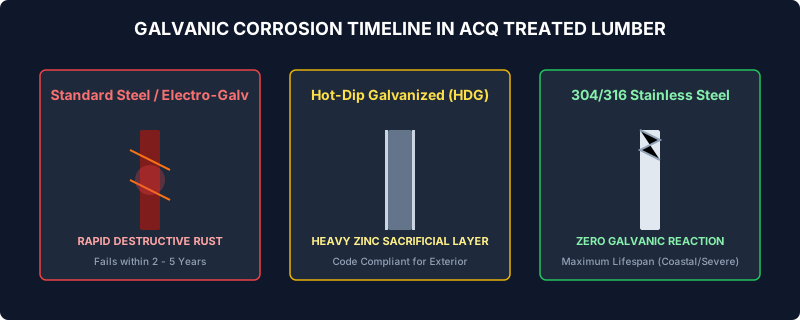
When an improper fastener—such as an electro-galvanized screw or standard bright steel framing nail—is driven into ACQ pressure-treated wood, the copper attacks the steel. Within just two to five years, the shank of the fastener can completely dissolve into dust inside the wood, while the head of the screw still appears fine from the outside. This creates a terrifying dynamic: a deck that looks visually sound from above but is supported by completely deteriorated steel beneath.
To avoid chemical corrosion, structural connections require hardware specifically rated for pressure-treated wood:
- Hot-Dip Galvanized (ASTM A153): Hardware coated with a thick molten layer of zinc, offering a protective barrier against copper leaching. Note that electro-galvanized (ASTM F1941) fasteners are far thinner and are not approved for exterior pressure-treated lumber.
- Proprietary Polymer Coatings: Engineered structural wood screws treated with multi-layer epoxy or ceramic coatings designed specifically to pass ASTM B117 salt spray testing.
- Stainless Steel (304 or 316 Grade): The ultimate defense against structural decay, imperative for coastal areas along Lake Erie or decks surrounding swimming pools.
The Northeast Ohio Climate Impact: Extreme Stress Factors
Living in Northeast Ohio presents distinct challenges for outdoor timber structures. Properties across Cuyahoga, Summit, Lake, Geauga, and surrounding counties experience extreme weather transitions that put deck framing under continuous physical stress.
1. Heavy Winter Snow Accumulation
The National Weather Service consistently documents Lake-Effect snow events delivering accumulated ground snow loads of 30 to 50 pounds per square foot (psf) across Northern Ohio. A typical 16×20-foot deck holding two feet of dense snow must carry an additional weight load of 9,000 to 12,000 pounds! If the ledger board fasteners are compromised by rust or constructed using non-structural fasteners, this sudden massive static load can trigger an immediate structural shear failure.
2. Severe Freeze-Thaw Thermal Expansion
During Northeast Ohio winters, water enters microscopic cracks around fastener penetration points. As temperatures fluctuate above and below 32°F, this trapped water expands by roughly 9% upon freezing. Over several seasons, this expanding ice forces fasteners to loosen, backs out structural nails, and widens screw holes, severely reducing overall holding capacity.
Fastener Identification Guide: Matching the Hardware to the Application
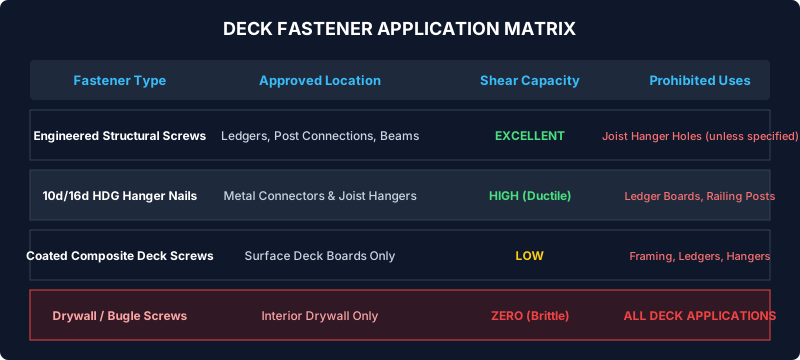
Using the wrong fastener in the wrong location is one of the most common defects noted in Pinnacle Inspection Services inspection reports. Below is a quick visual matrix summarizing appropriate hardware usage across deck components.
What Every Homeowner and Buyer Should Look For
Whether you are evaluating a home you plan to purchase or assessing the deck your family uses every weekend, perform this rapid visual safety checklist:
1. Inspect the Ledger Connection: Look beneath the deck where it meets the house. Can you see wide hex-head lag bolts or heavy structural screw heads stamped with manufacturer markings? If you only see small round nail heads, flat drywall screw heads, or worse—no visible fasteners at all—the deck is severely unsafe.
2. Examine Joist Hanger Fasteners: Look closely at the metal brackets holding the floor joists. Are all nail holes filled? Are there thin, gold, or silver drywall screws driven through the hanger holes? Fastener holes in metal connectors must be filled entirely with approved structural connector nails or short structural screws made specifically by the bracket manufacturer (such as Simpson Strong-Tie SD Connector Screws).
3. Check for Flashing and Rust Stains: Reddish-brown rust streaks running down the ledger board or joists indicate that non-galvanized metal is actively degrading inside the wood framing. Additionally, ensure proper metal Z-flashing sits over the top of the ledger board to direct rainwater away from the structural connection.
How can I tell if the screws in my deck ledger are structural or standard deck screws?
Structural wood screws engineered for ledger board attachment feature oversized, wide washer heads (often hex or star drive) and are stamped with structural identification codes (e.g., “LOK” or manufacturer marks) directly on the head. Standard deck screws have smaller, countersunk bugle heads designed to sit flush in deck boards and lack the necessary head diameter and shank thickness required to transfer structural heavy loads.
Can I fix an unsafe deck ledger by simply driving structural screws into the existing setup?
In many cases, an improperly fastened ledger board can be retrofitted by adding code-compliant engineered structural wood screws directly through the ledger into the house rim joist, provided the wood framing remains completely free of rot. However, proper spacing, staggered patterns, edge distances, and flashing integrity must all be verified during installation. If moisture has already rotted the ledger or house rim board, the entire structural connection must be rebuilt.
Why are joist hangers failing if they are filled with standard screws instead of hanger nails?
Joist hangers rely entirely on the shear strength of short, thick structural connector nails or specialized connector screws. Standard wood or deck screws driven through metal hangers have brittle steel shanks that quickly snap under vertical downward load. Additionally, standard wood screw shanks are thinner than the pre-punched holes in metal hangers, creating play that allows the joist system to shift and fail.
Ensure Your Deck is Safe for Family and Guests
A deck should be a safe space for outdoor relaxation, not a structural hazard waiting to fail under severe snow or dynamic weight loads. If you are buying a home in Northeast Ohio or want complete peace of mind regarding the structural integrity of your existing deck framing, Pinnacle Inspection Services is here to help. Contact Jim Husseini today to schedule a thorough, professional inspection that identifies structural hazards before they lead to costly repairs or catastrophic failure.