


Every home moves. Whether you own a historic Craftsman in Lakewood, a classic brick ranch in Parma, or a new build in Akron, your home is in a constant, dynamic relationship with the earth beneath it. As a Certified Professional Inspector in Northeast Ohio, I examine hundreds of foundations every year. The single most common question homeowners and buyers ask me is: “Is this crack just normal house settling, or is my foundation failing?” Distinguishing between minor aesthetic flaws and major structural movement is crucial for protecting both your safety and your financial investment.
- Crack Orientation Matters: Vertical cracks less than 1/8-inch wide are typically caused by natural soil drying or concrete curing, while horizontal and diagonal cracks often point to active structural movement.
- The 1/4-Inch Rule: Any wall or foundation gap exceeding 1/4 inch in width demands immediate evaluation by an experienced professional inspector or structural engineer.
- Northeast Ohio Soil Dynamic: Local expansive clay soils shrink during summer dry spells and swell during wet springs, putting intense lateral hydro-static pressure on basement walls.
- Secondary Warning Signs: Sticking doorframes, jamming windows, cracked chimney masonry, and sloping interior floors almost always accompany true structural settling.
- Monitoring Over Time: Installing simple tell-tale crack monitors allows you to track whether a gap is stable or actively expanding with seasonal temperature shifts.
Understanding Northeast Ohio Soil Dynamics and Foundations
To accurately evaluate house cracks, you must first understand what is happening under your feet. Northeast Ohio possesses a distinct geological profile that presents unique challenges to residential foundations. Our soil composition consists largely of dense, clay-rich glacial till. Clay is an highly expansive material; it acts like a dense sponge. During wet spring thaws and autumn rains, clay absorbs vast quantities of water and expands significantly. Conversely, during hot, dry summer periods, that same clay dries out, shrinks, and pulls away from your home’s foundation footings.
This perpetual expansion-and-contraction cycle subjects foundation walls to immense force. In winter, our extreme freeze-thaw cycles compound this dynamic. When moisture trapped in the soil surrounding your basement freezes, it expands by roughly nine percent, driving intense lateral hydro-static pressure inward against foundation walls. Over decades, this relentless push-and-pull causes materials to flex, shift, and inevitably crack.

Differentiating Normal House Cracks from Structural Settling
Every home experiences two distinct types of movement: initial curing/settlement and active structural displacement. Knowing how to tell them apart saves home buyers and homeowners unnecessary panic while ensuring critical issues are caught before turning into catastrophic failures.
Cosmetic & Normal Shrinkage Cracks
When a home is newly constructed, thousands of gallons of water are locked inside the building materials—from poured concrete foundations to wood framing studs and drywall compound. As these materials dry out over the first two to five years, they shrink. This natural curing process produces cosmetic cracks that are structurally harmless:
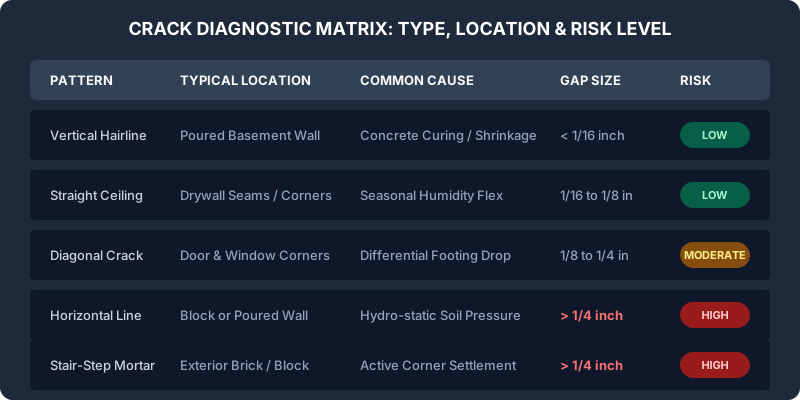
- Vertical Concrete Shrinkage Cracks: Straight, narrow vertical cracks running down a poured concrete basement wall are usually harmless curing cracks. They generally maintain a uniform width (under 1/8 inch) top to bottom.
- Drywall Seam Cracks: Straight horizontal or vertical lines on interior walls and ceilings, particularly along drywall tape joints, are cosmetic signs of wood framing adjusting to seasonal indoor humidity shifts.
- Hairline Floor Slab Cracks: Basement and garage concrete floor slabs do not support the weight of your home’s exterior walls. Minor surface cracks in floor slabs are virtually universal and rarely structural.
Active Structural Settling Red Flags
Structural settling occurs when the foundation footings drop, shift, or bow beyond engineered tolerances because the underlying soil can no longer support the weight. These cracks exhibit distinct patterns created by tension and shear forces:
- Horizontal Foundation Cracks: A horizontal crack running along a concrete block wall or poured basement wall is a serious structural red flag. It indicates that external soil pressure or frost heavage is pushing the wall inward, causing structural failure along the mortar joints.
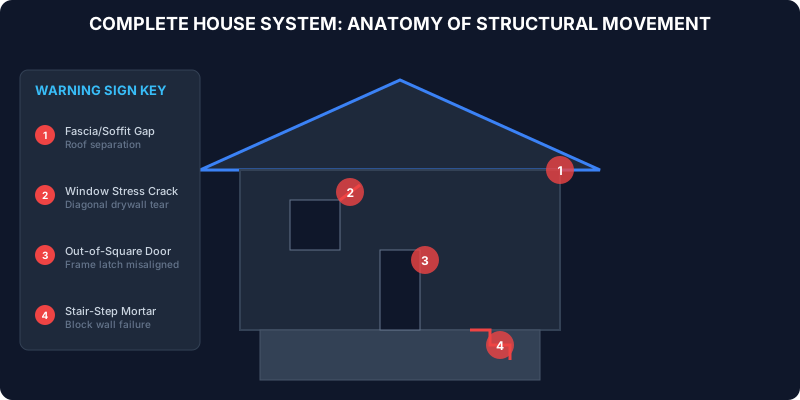
- Stair-Step Masonry Cracks: Found on exterior brick, stone veneer, or basement block walls, these cracks follow the mortar lines up and across in a step pattern. Gaps wider than 1/4 inch indicate differential settlement, where one corner of the foundation is sinking faster than the rest.
- Diagonal Corner Drywall Cracks: Cracks extending diagonally outward from the upper corners of door and window frames indicate that the house frame is twisting as the foundation below drops unevenly.
Visual Inspection Checklist: Indoors and Outdoors
When conducting a structural evaluation, an inspector never looks at a single crack in isolation. True structural failure leaves a trail of secondary evidence throughout the home. Here is what I search for during a comprehensive Pinnacle Inspection Services evaluation:
Interior Red Flags
- Sticking Doors and Latching Issues: When a house settles unevenly, door frames skew out of square. If interior doors suddenly stick at the top corner, pop open on their own, or no longer latch properly into the strike plate, movement is occurring.
- Sloping or Bouncing Floors: Take a marble or small round level and set it in the middle of your living room floor. If it rolls decisively toward an exterior wall, or if you feel distinct soft spots near load-bearing walls, floor joists may have shifted off their beam supports.
- Gaps Above Baseboards: If baseboard molding separates from the hardwood or carpeted floor, leaving a visible gap, the floor structure below may be sagging while the exterior wall stays in place.
Exterior Red Flags
- Fascia and Soffit Gaps: Step outside and look up at your roofline. Gaps opening up between the roof fascia, gutters, and siding indicate that an exterior corner of the home is pulling downward away from the main framing.
- Leaning Chimneys: Masonry chimneys rest on their own heavy concrete pads. If that pad settles independently from the home’s main foundation, you will see a widening gap between the chimney structure and exterior siding.
- Soil Separation and Trenching: Check the perimeter ground surrounding your foundation wall. If you spot a distinct gap where soil has pulled away from concrete walls, water will pool directly against your footings during the next rainstorm.
Measuring and Monitoring Crack Progression
If you discover a crack in your foundation or interior drywall, do not immediately assume worst-case scenarios. The key question is whether the crack is dormant (static) or active (continuing to move). Homeowners can track movement using basic DIY methods or professional crack monitoring tools.
The simplest DIY method involves making two clean pencil tick marks across the crack on either side, then measuring the distance between them down to the millimeter. Note the date and measurement on a piece of masking tape next to the crack. Re-measure every three months across changing weather seasons (e.g., peak winter, spring thaw, summer dry spell).
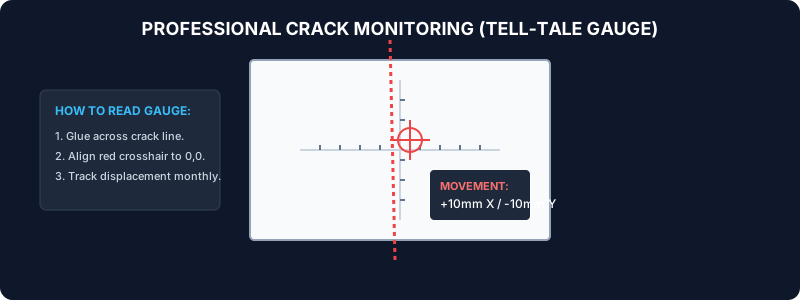
For high-precision tracking, professionals install a Tell-Tale Crack Monitor Gauge. This device consists of two overlapping acrylic plates. One plate features a millimeter grid, while the other features a red crosshair target. By gluing the two sides across a crack, any movement—whether horizontal opening or vertical shear displacement—becomes immediately visible on the grid scale down to 0.5 millimeters.
Remediation Strategies and When to Call a Certified Professional
Repairing foundation movement requires selecting a solution tailored to the root cause of the displacement. Unqualified repairs, such as simply smearing hydraulic cement over an active structural crack, only mask the symptom while underlying damage progresses.
Level 1: Water Management & Drainage Correction
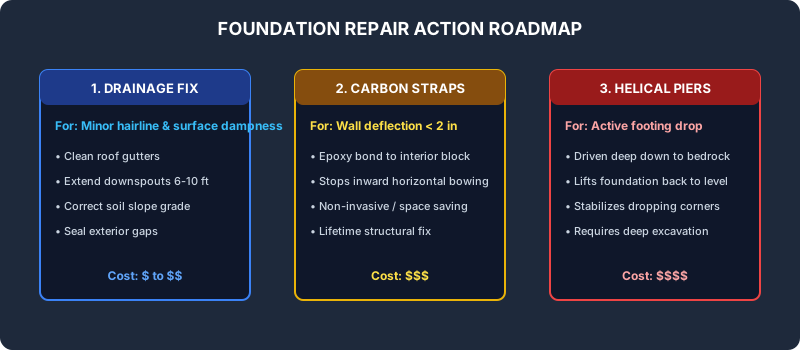
In Northeast Ohio, over 80 percent of foundation issues stem directly from improper roof drainage. Before investing thousands of dollars in structural underpinning, examine your gutters and downspouts. Ensure gutter troughs are clean and free of debris, and install downspout extension pipes to discharge roof runoff at least 6 to 10 feet away from foundation walls. Ensure the grade around your soil slopes downhill away from the structure at a rate of 6 inches over the first 10 feet.
Level 2: Carbon Fiber Reinforcement Straps
When concrete block basement walls experience horizontal cracking and inward deflection under 2 inches, carbon fiber straps provide an ideal, non-invasive engineered solution. High-tensile strength carbon fiber straps are bonded vertically to the interior face of the basement wall using structural epoxy. Once cured, these straps stabilize the wall, preventing any further inward bowing without excavating your lawn.
Level 3: Helical Piers & Steel Underpinning
If your foundation footings are actively sinking into soft clay, structural underpinning becomes necessary. Structural contractors drive heavy-duty steel helical piers deep into the earth beneath your footings until they reach solid bedrock or dense load-bearing soil strata. Hydraulic jacks then stabilize or carefully lift the foundation back toward its original level position.
How fast does structural settling occur in Northeast Ohio?
Initial curing settling occurs within the first 2 to 5 years after construction and then stabilizes. However, structural settling caused by expansive clay soil erosion, freeze-thaw pressure, or poor drainage occurs progressively over many years. Severe weather events, such as torrential spring storms or rapid winter thaws, can cause sudden minor acceleration, but total foundation failure is almost always a slow process that gives ample warning signs over months and years.
Will hairline drywall cracks lower my home’s resale value?
Hairline drywall cracks under 1/8-inch wide are extremely common cosmetic findings in Northeast Ohio homes and typically do not hurt your home’s resale value, provided they are properly explained during the buyer’s home inspection. However, unmonitored cracks wider than 1/4 inch or those accompanied by sticking doors will raise immediate red flags for buyers’ inspectors and mortgage appraisers, often requiring a formal engineer’s evaluation before home sales can proceed.
Can poor gutter drainage cause foundation cracking?
Yes, clogged gutters and short downspout discharge lines are the leading cause of structural foundation cracking in our region. When rainwater dumps directly along your foundation wall, it saturates the clay soil. This saturated clay exerts tremendous lateral pressure against basement walls in summer and freezes into expanding ice blocks in winter, directly causing horizontal and stair-step wall cracking.
Thinking of buying or selling a home in Northeast Ohio, or concerned about cracks in your current foundation? Don’t leave your biggest investment to guesswork. Contact Jim Husseini, B.S., C.P.I. at Pinnacle Inspection Services today to schedule a comprehensive, unbiased structural home inspection that gives you total clarity and peace of mind.