

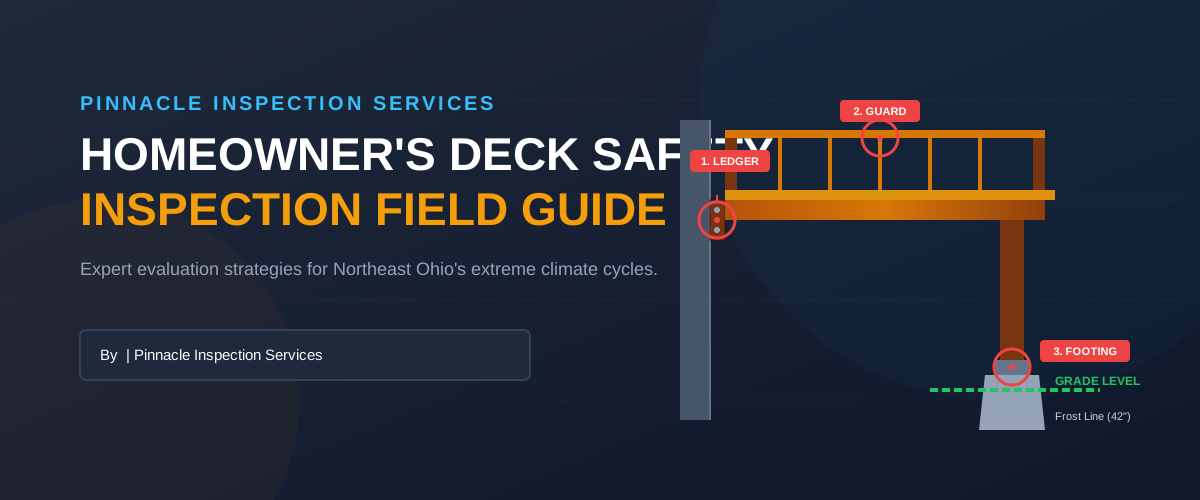
Decks are an integral part of outdoor living in Northeast Ohio, offering a space to relax and entertain during our beautiful spring, summer, and autumn months. However, because decks are continuously exposed to severe weather conditions—ranging from heavy snow loads and freeze-thaw cycles to intense rain and humidity—their structural integrity degrades over time. According to the North American Deck and Railing Association (NADRA), millions of decks across North America are past their useful lifespan and pose potential safety risks. Routine self-inspections allow homeowners and potential buyers to identify warning signs long before they result in catastrophic structural failure.
- Ledger Board Integrity: Over 90% of structural deck collapses originate from failure at the ledger board connection.
- Northeast Ohio Climate Impact: Deep frost heave and continuous freeze-thaw expansion require footings to sit at least 42 inches below grade.
- Fastener Corrosion: Modern pressure-treated chemicals accelerate metal hardware corrosion if improper fasteners are used.
- Guardrail Safety: Guardrails must withstand 200 pounds of direct force and have balusters spaced under 4 inches apart to protect children.
- Wood Rot Identification: Unchecked moisture retention leads to rot that compromises structural posts, joists, and beams.
1. The Critical Connection: Inspecting the Ledger Board
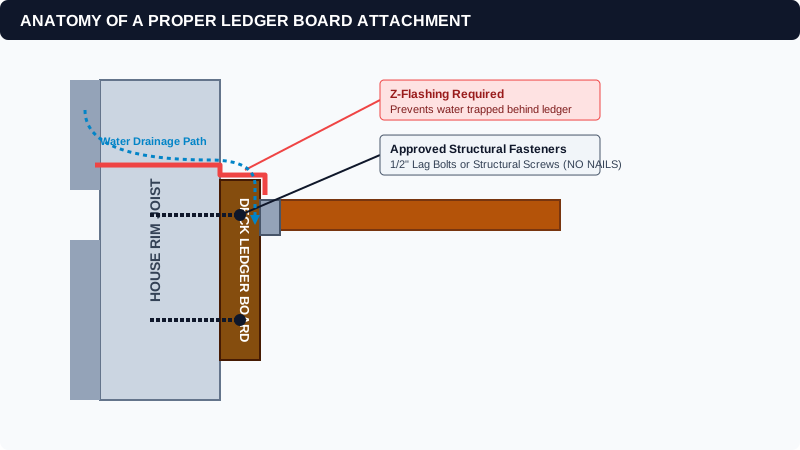
The ledger board is the single most critical structural component of any house-attached deck. It is the heavy wooden beam that fastens the deck directly to the framing of your home, bearing approximately half of the deck’s total weight. When a deck collapses, it is almost always because the ledger board pulled away from the house wall due to improper fasteners or hidden water damage.
To inspect your ledger board, start by getting beneath the deck with a bright flashlight. Check to see how the ledger is fastened to the rim joist of your house. Code requirements strictly dictate the use of half-inch lag screws or approved structural wood screws installed in a staggered pattern. Nails should never be used to attach a ledger board to a house. Nails possess low withdrawal resistance and will gradually pull out under shear loads and thermal expansion.
Flashing and Water Intrusion Prevention
Proper flashing is essential to keep water from seeping behind the ledger board. Without flashing, trapped water rots the deck ledger, the house rim joist, and the wall framing. Look for continuous metal or heavy-duty vinyl Z-flashing installed along the top edge of the ledger board, extending behind the siding. If you notice rusted metal flashing, missing flashing, or soft, spongy wood along the house connection, immediate professional intervention is necessary.
2. Substructure, Posts, and Footings in Northeast Ohio
The framing beneath the deck boards bears the live load of people and furniture, along with the environmental dead load of snow and ice. In Northeast Ohio, the deep freeze-thaw cycles present distinct engineering challenges for outdoor structures.
Frost Depth and Concrete Piers
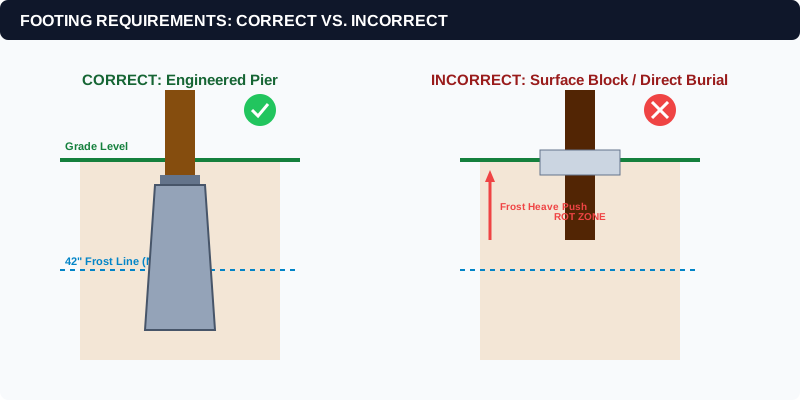
Because northern Ohio soils freeze and expand significantly during winter, support posts must rest on solid concrete footings poured at least 42 inches deep—well below the frost line. Posts placed directly on the ground, or supported merely by pre-cast surface concrete blocks (floating footings), are vulnerable to vertical heave during winter freezes. Over time, frost heave distorts the deck frame, weakens fasteners, and can tear the ledger board away from the home.
Verify that each vertical post connects to its concrete pier using elevated metal post bases. Wood posts embedded directly into concrete or dirt absorb ground moisture continuously, accelerating wood decay and rot at ground level.
3. Fasteners, Joist Hangers, and Hardware Corrosion
A deck’s strength depends entirely on its mechanical connections. Joist hangers, post brackets, beam connectors, and screws form the continuous load path that transfers deck weight into the ground.
Inspect all metal hardware from underneath the deck using these parameters:
- Proper Connectors: Every joist ending at a ledger or rim joist should sit securely in a dedicated metal joist hanger. End-nailing joists without structural metal hangers relies entirely on the bending strength of a few nails, which will sag over time.
- Fastener Compatibility: Modern pressure-treated lumber contains copper compounds that act aggressively toward standard steel. Connectors and nails must be hot-dipped galvanized or stainless steel. Mixing metals—such as using standard interior screws in treated wood or galvanized hangers—causes rapid galvanic corrosion.
- Missing Fasteners: Check every hole in every joist hanger. Builders occasionally skip filling all manufacturer holes, which reduces the connector’s rated load capacity. Structural connector screws or joist hanger nails must fill every designated opening.

4. Guardrails, Handrails, and Safety Clearances
Guardrail failures are a leading cause of deck-related injury. A guardrail must serve as a sturdy barrier capable of stopping a falling adult without flexing or detaching from the structure.
Height, Spacing, and Load Requirements
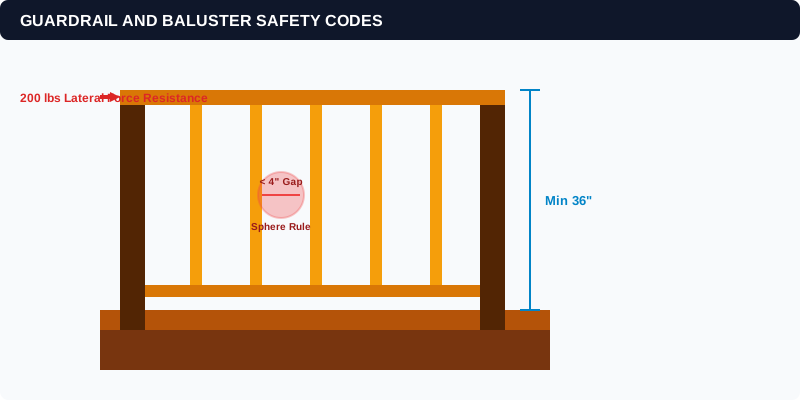
Building codes state that any deck elevated higher than 30 inches above the surrounding ground level must feature a continuous guardrail. The minimum safety dimensions for guardrails include:
- Minimum Height: Residential guardrails must stand at least 36 inches tall measured from the deck floor to the top of the rail.
- Baluster Clearance (The 4-Inch Rule): Vertical balusters or spindles must be spaced so that a 4-inch diameter sphere cannot pass between any two posts. This spacing requirement prevents small children from slipping through or becoming trapped.
- Sweep Space at Floor: The gap between the bottom rail and the deck surface must not exceed 4 inches.
- Structural Post Attachment: Guardrail posts must be securely bolted to the deck framing joists with metal hold-down tension ties or carriage bolts. Guardrail posts held in place by decking screws alone will fail under lateral pressure.
5. Decking Surface Evaluation and Wood Rot “Pick Test”
While structural safety under the deck is critical, the decking surface presents immediate slip and trip hazards. Splitting, cupping, protruding screws, and decay must be routinely monitored.
Performing the Structural Pick Test
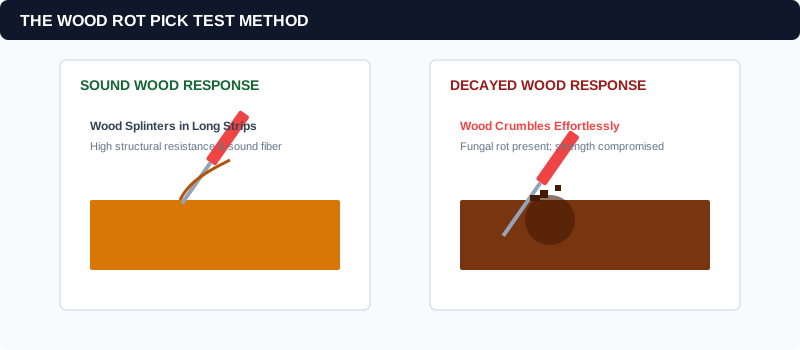
To evaluate the structural soundess of suspect wood members, perform a simple “pick test” using a flat-head screwdriver or an awl:
- Locate areas prone to moisture retention, such as end-grain joints, wood contacting soil, or spots underneath planters and outdoor rugs.
- Pry beneath the outer fibers of the wood with your screwdriver at a shallow angle.
- Healthy Wood Behavior: The wood resists entry, and when pried, long splintered strips break away cleanly with a snapping sound.
- Decayed Wood Behavior: The tool penetrates effortlessly, and the wood breaks off in short, crumbly chunks without splintering. This indicates active fungal decay (rot) and diminished structural capacity.
Stair Stringer and Tread Safety
Stairs experience high dynamic impact loads and require careful inspection. Ensure stair stringers (the diagonal framing members supporting stair treads) are firmly anchored to the deck frame at the top and rest on a concrete pad at the base. Open risers between stair treads must not allow a 4-inch sphere to pass through, matching guardrail safety standards.
How often should I inspect my deck in Northeast Ohio?
You should perform a visual inspection of your deck at least once a year, preferably in early spring after the winter snow melt. Additionally, a professional inspection should be conducted every three to five years, or prior to buying or selling a home, to verify hidden structural connections and fastener conditions.
Can I use nails to attach a ledger board to my home?
No. Nails should never be used to attach a ledger board. Nails lack sufficient withdrawal resistance and can pull straight out of the house framing under heavy snow loads or dynamic movement. Code requires hot-dipped galvanized or stainless steel lag bolts or approved engineered structural timber screws.
How do I know if deck wood rot is structural or cosmetic?
Cosmetic weathering involves light surface graying and minor hairline cracking, which are normal for exterior wood. Structural rot involves soft, spongy wood that crumbles easily during a pick test, deep cracks running along structural beams, or loose connections where fasteners no longer hold grip. If structural members like posts, ledger boards, or joists show signs of rot, repair or replacement is required.
Performing regular visual inspections of your deck is one of the most effective ways to protect your family and extend the life of your outdoor living space. However, subtle structural defects, hidden framing rot, and complex ledger flashing issues can easily be overlooked by the untrained eye.
If you are buying a home, preparing to sell, or simply want total peace of mind regarding the safety of your existing deck, trust the certified expertise of Pinnacle Inspection Services. Led by Jim Husseini B.S., C.P.I., we offer exhaustive, professional home and deck safety inspections throughout Northeast Ohio. Contact Pinnacle Inspection Services today to schedule your comprehensive home inspection!