

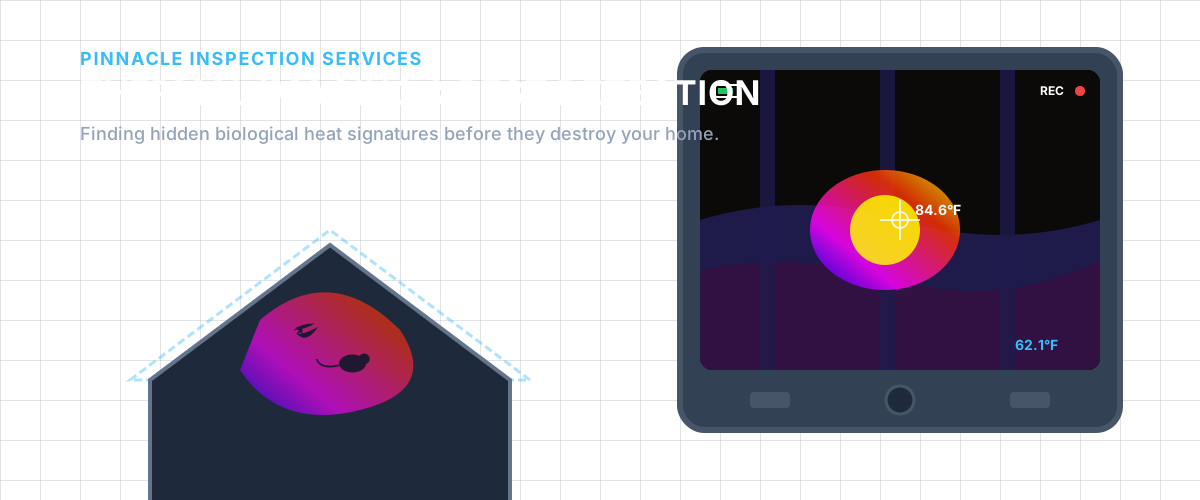
When you look at a home with the naked eye, you only see the surface. The pristine drywall, the fresh coat of paint, or the clean siding can easily mask a destructive, living chaos unfolding inside the wall cavities. In Northeast Ohio, our extreme seasonal shifts force pests of all shapes and sizes to seek refuge. Whether it is a colony of wood-destroying carpenter ants chewing through damp structural framing, a massive bald-faced hornets’ nest pulsing with activity, or a family of mice tearing up your insulation to build cozy winter nests, these unwanted guests are experts at hiding. However, they cannot hide their heat. At Pinnacle Inspection Services, we use advanced infrared thermography (thermal imaging) to reveal the invisible heat signatures and thermal anomalies that point directly to active pest infestations.
- Invisible Detection: High-resolution thermal cameras reveal heat signatures from active pest nests that are completely invisible to the naked eye.
- Structural Protection: Pinpointing infestations early prevents severe, costly structural damage from wood-boring pests.
- Insulation Integrity: Thermal imaging detects the cold voids left behind when rodents shred insulation for nesting materials.
- Non-Invasive Diagnostics: Avoid tearing down drywall unnecessarily; thermal imaging allows us to inspect wall cavities without leaving a mark.
- Targeted Remediation: Provide your pest control technician with exact GPS-like coordinates of the nest inside your walls for highly targeted treatment.
The Science of Thermography in Pest Detection
To understand how thermal imaging finds pests, we must dispel a common myth: infrared cameras do not give the inspector “X-ray vision.” They do not look through walls. Instead, they measure surface temperature differentials. Every object with a temperature above absolute zero emits infrared radiation. Thermal cameras detect this radiation and convert it into a highly detailed visual map of temperature variations, known as a thermogram.
When pests invade a residential wall cavity, ceiling, or crawlspace, they disrupt the normal thermal profile of the home in two distinct ways: biological heat production and material displacement.
Biological Heat Production
Warm-blooded animals like mice, rats, squirrels, and raccoons naturally emit body heat. When these animals cluster together inside a nest to breed or stay warm during a harsh Northeast Ohio winter, they create a highly concentrated “hot spot.” Even cold-blooded insects, when gathered in massive quantities, generate measurable metabolic heat. A mature nest of yellowjackets, hornets, or carpenter ants contains thousands of vibrating bodies. This collective energy raises the local temperature of the drywall or ceiling directly adjacent to the nest, showing up as a bright, glowing anomaly on our camera screens.
Material Displacement (Thermal Bridging)
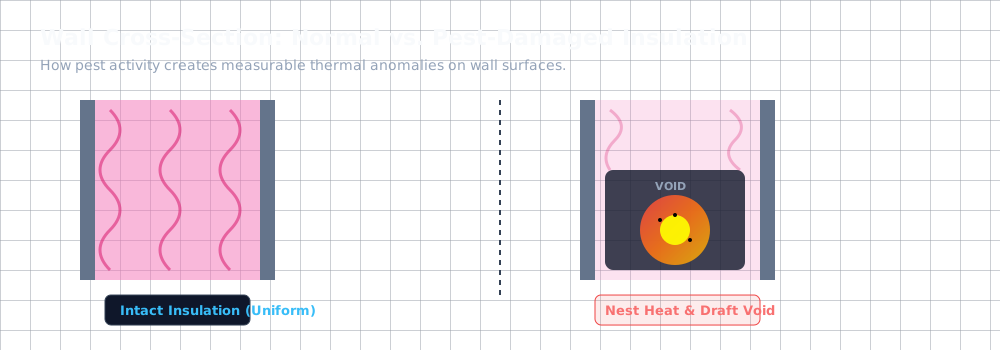
Pests are destructive builders. To make room for their nests, rodents chew through, shred, and push aside fiberglass batt or cellulose insulation. This nesting behavior leaves empty voids in the wall cavity. Without insulation, outside temperatures quickly penetrate the wall, creating a stark “cold spot” (in the winter) or “hot spot” (in the summer) compared to the surrounding, properly insulated areas. This thermal bridging stands out immediately during a professional thermal scan.
Northeast Ohio’s Most Common Hidden Home Invaders
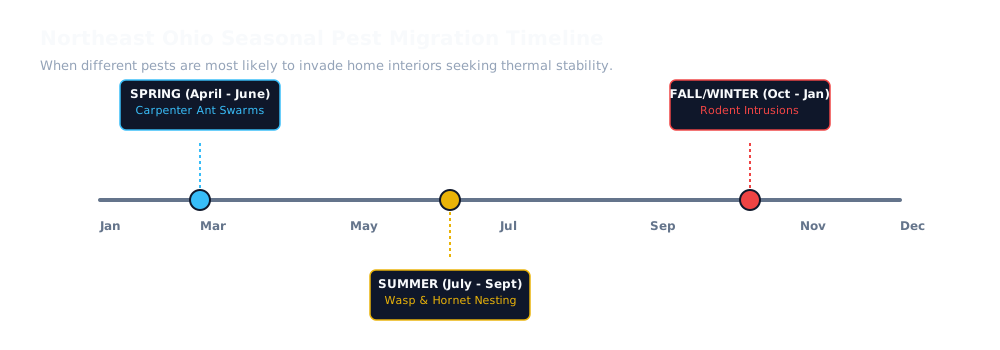
Every geographical region faces its own unique suite of structural pests. In Northeast Ohio, our climate spans from sub-zero, lake-effect snowstorms in January to sweltering, high-humidity days in July. This dramatic climate swing pushes local pests deep inside our climate-controlled homes. Here are the primary culprits we locate using thermal imaging:
1. Carpenter Ants
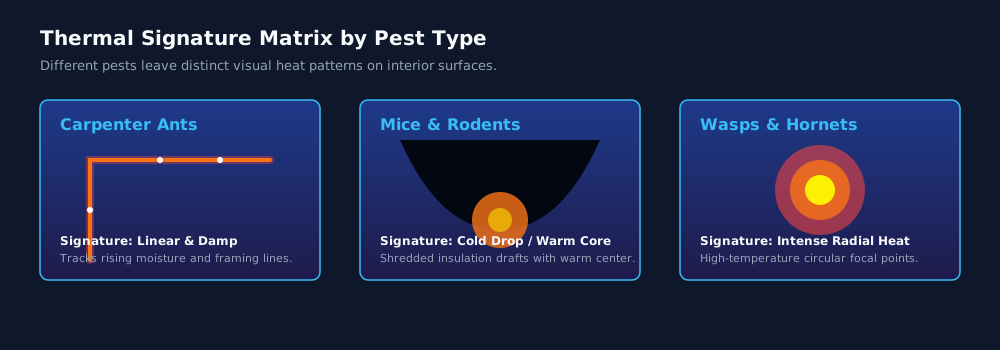
Unlike termites, carpenter ants do not actually eat wood; instead, they hollow it out to build smooth nesting galleries for their rapidly expanding colonies. They are particularly drawn to wood that has been softened by moisture or slow roof/plumbing leaks—a common issue in Northeast Ohio’s historic home stock. Because they require moisture to survive, their nests are highly humid and warmer than the surrounding dry framing. Under the thermal lens, an active carpenter ant satellite nest appears as a localized “hot spot” tracking along damp ceiling joists or wall studs.
2. Rodents (Mice and Rats)
As the autumn chill sets in, mice and rats seek immediate warmth. They frequently enter through microscopic foundation cracks or gaps under the siding, heading straight for the attic or wall voids. Once inside, they aggressively tear apart fiberglass insulation to build soft, circular nests. The loss of insulation causes immediate cold drafts to settle against the drywall. On our thermal screen, a rodent-infested wall displays a telling signature: a cold, dark blue draping pattern (where the insulation has settled or been removed) surrounding a sharp, warm red-orange pocket (the physical rodent nest itself).
3. Wasps, Yellowjackets, and Hornets
During the late summer and early autumn, yellowjackets and hornets are at their peak population. They frequently chew through deteriorated exterior trim or mortar joints to establish massive nests inside wall cavities. A single nest can easily contain several thousand highly active, buzzing insects. The collective kinetic energy and metabolic heat generated by a thriving yellowjacket colony can easily raise the temperature of the interior drywall by 5°F to 15°F. On a hot summer afternoon, we can easily pinpoint the exact margins of a live nest, allowing for localized pest control treatment rather than guessing where to spray or cut.
How We Interpret the Thermal Screen: Real-World Scenarios
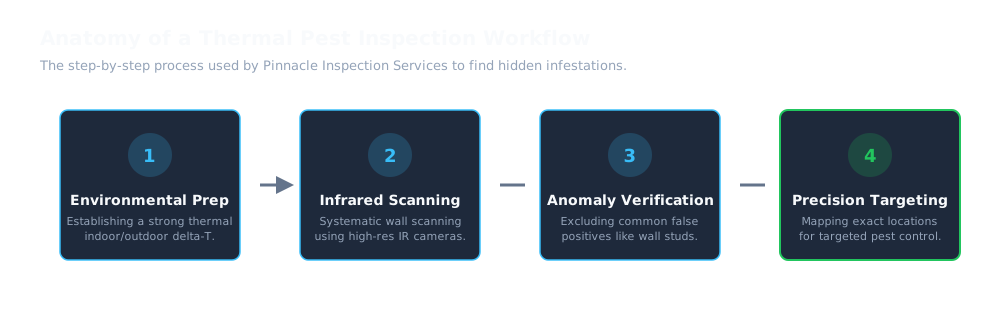
Operating a thermal camera requires advanced technical training and a solid grasp of building science. A common error made by inexperienced inspectors is misinterpreting normal building characteristics as active problems. This is known as “false-positive” targeting.
For instance, during a hot summer afternoon in Northeast Ohio, a wall stud can naturally absorb and retain solar heat through conduction. This creates a vertical “hot stripe” that could easily be mistaken for pest activity by an untrained eye. A certified professional, however, knows to analyze the shape, patterns, and surrounding environmental factors before jumping to conclusions.
- Convective Patterns: Hot air naturally rising through empty wall cavities creates a diffuse, flame-like thermal signature that tapers off near the ceiling.
- Conductive Patterns: Solid wood framing conducts outdoor heat or cold more readily than insulated voids, creating uniform, sharp, linear patterns.
- Biological Patterns: Pest heat signatures are localized, non-uniform, irregular, and do not conform to the clean, straight lines of standard framing lumber.
By comparing the thermal signatures against known construction patterns, we can confidently isolate anomalies that require further, targeted investigation.
Case Studies from the Field: Real Cleveland Area Homes Saved
To truly appreciate the value of infrared home inspections, consider these two common scenarios we frequently encounter throughout Northeast Ohio:
Case Study 1: The Invisible Hornet Nest in Shaker Heights
A homeowner in Shaker Heights noticed a few yellowjackets hovering around their second-floor window frame. Inside the bedroom, they could hear a faint, intermittent buzzing sound behind the plaster wall, but there were no physical openings or structural clues. Rather than drilling exploratory holes across the wall cavity, we performed a thermal scan of the room. A massive, glowing hot circle about 18 inches in diameter registered on our screen, located near the top plate of the wall. We marked the exact boundaries of the nest on the wall using light tape. The exterminator drilled one tiny, single injection hole directly into the center of our marked boundary, resolving the entire issue in a single afternoon without damaging the surrounding, historic lath-and-plaster wall.
Case Study 2: The Drafty Floorboards in Westlake
A Westlake home buyer wanted a comprehensive inspection of a gorgeous, older colonial-style home. During our walk-through, our thermal camera picked up a series of cold, sweeping thermal patterns along the baseboards of the dining room. Further analysis of the crawlspace directly below revealed that mice had completely gutted the fiberglass insulation batts to construct nested nursery hubs. The previous seller had no idea they had a rodent infestation, as there were no droppings or visual signs in the main living areas. Thanks to the thermal scan, the buyer negotiated a credit to cover professional rodent treatment and complete insulation replacement, saving them thousands of dollars in hidden repair costs down the road.
Can a thermal camera see pests through concrete or brick?
No. Thermal cameras measure surface temperature variations and cannot “see through” dense, high-mass materials like solid brick or poured concrete walls. However, if pests (such as rodents or insects) nesting inside a brick-veneer cavity wall produce enough collective heat or disrupt the cavity insulation, that thermal difference will eventually conduct to the interior drywall surface, allowing us to detect it from the inside.
Do pests have to be active at the exact moment of the inspection for the camera to find them?
Yes, for active heat signatures. To detect the biological metabolic heat of pests, the insects or animals must be present and active in the nesting cavity. However, if the pests have vacated but left behind significant structural damage—such as tunnels in wood framing or torn-up wall insulation—we can still detect the resulting “cold/warm voids” caused by air leaks and lost thermal resistance, indicating a past or ongoing structural issue.
Is a thermal imaging scan included in a standard home inspection?
While many basic home inspectors perform a simple visual walk-through, a comprehensive thermal scan requires advanced, specialized equipment and professional certification. At Pinnacle Inspection Services, we believe in utilizing the absolute best technology available to protect your investment. We offer thermal imaging as a critical, high-value component of our advanced inspection packages to ensure nothing is hidden behind the walls before you buy or sell your home.
Protect your home and family from the costly, hidden dangers of pest intrusions. Whether you are buying a historic home in Cleveland Heights, selling a property in Westlake, or simply want to ensure your current home is structurally sound, let Jim Husseini and the experienced team at Pinnacle Inspection Services bring the invisible to light. Contact us today to schedule your comprehensive, high-resolution thermal imaging inspection and secure absolute peace of mind for your property.