
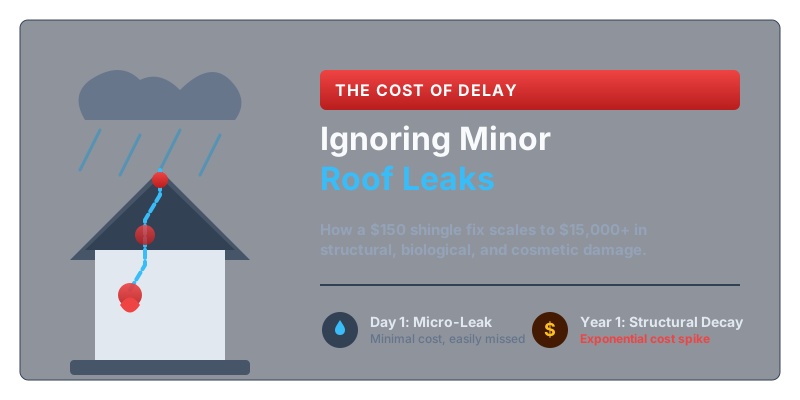
To many homeowners in Cleveland, Akron, and across Northeast Ohio, a minor ceiling stain or a periodic drip during a heavy spring downpour seems like an issue that can wait. With busy schedules, mortgage payments, and the general demands of property maintenance, it is tempting to relegate a small roof leak to the bottom of your home improvement to-do list. However, as a certified home inspector who has analyzed thousands of attics and roof systems throughout our region, I can tell you with absolute certainty: there is no such thing as a stable roof leak. What starts as a displaced shingle or a cracked pipe boot during a rough Lake Erie storm quickly translates into an active, escalating threat to your home’s structural integrity, indoor air quality, and financial value.
- Compounding Damage: Water damage does not scale linearly; it scales exponentially as moisture spreads through insulation, drywall, and structural framing.
- Severe Health Risks: Unchecked moisture in enclosed spaces like attics can spark toxic mold growth in as little as 24 to 48 hours.
- Insulation Failure: Saturated insulation permanently loses its R-value, drastically raising your heating and cooling costs in Northeast Ohio’s volatile climate.
- Insurance Denials: Most insurance carriers will deny coverage for water damage claims if they determine the root cause was long-term neglect rather than a sudden, catastrophic event.
The Anatomy of a Slow Leak: How Water Behaves Inside Your Home
When gravity brings rainwater down onto your roof, any breach in the outer defense barrier acts as a siphon. Water does not always travel straight down. It follows the path of least resistance, which often means trickling along the underside of roof sheathing, running down rafters, pooling on top of ceiling joists, and eventually finding an escape path through drywall seams, light fixtures, or attic bypasses.
By the time you actually notice a brown circle forming on your living room ceiling or see water dripping from a crown molding seam, the leak has likely been active for months. It has already saturated the structural components above that ceiling. This hidden migration makes locating the source of the leak incredibly difficult without thermal imaging cameras and professional moisture meters.
The Northeast Ohio Climate: A Catalyst for Rapid Roof Decay
Our local weather patterns here in Northeast Ohio are uniquely brutal on roofing systems. We experience severe freeze-thaw cycles, lake-effect snow accumulation, high-velocity winds, and heavy spring rains. This dramatic shift in weather acts as a force multiplier for roof damage.
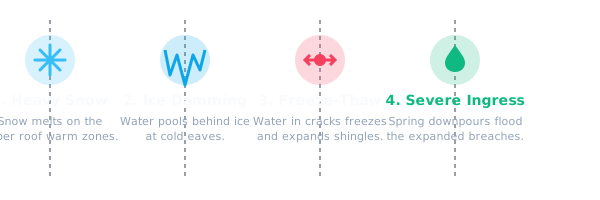
Consider the process of ice damming. When snow melts on the upper portions of your roof and refreezes at the colder eaves, it forms a solid block of ice. Meltwater pooling behind this ice barrier has nowhere to go. It is forced backward up the roof slope, driving under shingles and past standard underlayments. If you have an unresolved micro-leak, this backup of ice and water dramatically widens the gap, turning a minor issue into a major, fast-flowing source of structural compromise.
The Real Danger of OSB and Plywood Decking Deflection
Modern homes typically use Oriented Strand Board (OSB) or plywood for roof sheathing. When OSB gets repeatedly wet, the adhesives holding the wood strands together degrade, causing the board to swell, delaminate, and lose its structural capacity. When walking a roof during a professional home inspection, soft spots underfoot are clear evidence of advanced wood rot. If left unaddressed, the roof decking eventually loses its ability to hold nails, requiring a complete structural tear-off instead of a simple patch job.
The Exponential Escalation: Timeline of an Unresolved Leak
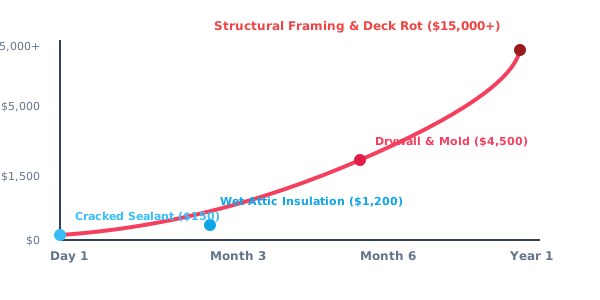
To help homeowners visualize how quickly costs escalate, let’s look at the lifecycle of an untreated roof leak over the span of a single year. Proactive maintenance is always a fraction of the cost of reactive reconstruction.
Stage 1: The Initial Breach (Day 1 – Month 1)
An aging rubber collar around a plumbing vent pipe cracks, or a high wind event lifts a single shingle tab. Water begins to seep into the roof decking during heavy rains. At this stage, the homeowner is completely unaware of the issue. The repair cost is limited to a fast, simple sealant application or single-shingle replacement, costing between $150 and $300.
Stage 2: Insulation Saturation (Months 2 – 4)
The water continuously drips onto the fiberglass or cellulose insulation directly beneath the leak. Insulation acts like a sponge, soaking up gallons of water. Wet insulation loses its structure and its ability to trap air, drastically degrading its R-value. This forces your furnace or air conditioner to work harder to maintain indoor temperatures. At this point, dry rot can begin setting into attic joists, and repair bills jump to $1,000–$2,500 to replace insulation, seal the leak, and treat framing.
Stage 3: Biological Growth & Ceiling Damage (Months 5 – 9)
The ceiling drywall below the saturated insulation becomes fully waterlogged. A dark water stain appears on your ceiling. Due to the dark, warm, and humid conditions in your attic, mold spores begin to colonize structural timbers, paper drywall backing, and insulation. Spores can enter your home’s living areas through attic bypasses, degrading your indoor air quality. Remediating mold, replacing damaged drywall, and repairing the source of the leak now averages $3,500 to $6,000.
Stage 4: Structural Failure & Total System Compromise (Year 1+)
After a full cycle of Northeast Ohio seasons, the framing (rafters and joists) begins to rot. Structural wood becomes spongy and warped, causing sag lines visible on the exterior roof ridge. Complete sections of decking are structurally compromised. The damp environment can also short out electrical wiring, presenting a severe fire risk. At this point, localized repairs are no longer an option. You are now looking at a major construction project involving framing replacement, mold remediation, and a full roof replacement, easily exceeding $15,000 to $20,000.
Hidden Hazards of Long-Term Leaks: Behind the Drywall
Most homeowners focus entirely on the aesthetic damage of a roof leak, such as peeling paint or stained plaster. However, the most severe consequences of long-term water intrusion happen completely out of sight.
1. Biological Contamination and Health Issues
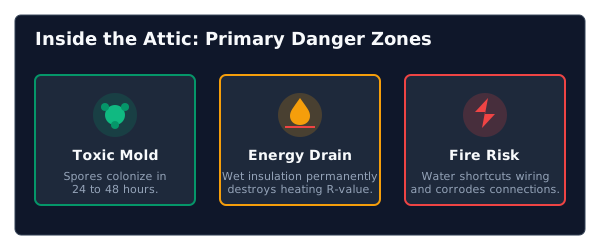
When moisture mixes with organic building materials like drywall paper, wood, and dust, it creates an ideal breeding ground for mold species like Stachybotrys chartarum (commonly known as black mold) and Aspergillus. These molds release airborne spores and mycotoxins into your attic. Thanks to the stack effect (the movement of air upward through your home), attic air and the biological contaminants it carries are drawn down into your lower living spaces. This can trigger chronic allergies, asthma, and severe respiratory symptoms, particularly in children and elderly family members.
2. Severe Reduction in Home Energy Efficiency
The effectiveness of insulation depends on its ability to trap microscopic pockets of air. When water fills these pockets, the insulation loses its ability to resist heat transfer. Saturated insulation becomes heavy, packs down, and loses its structural loft. Even after the insulation dries out, it remains permanently compressed, leaving your home poorly insulated. This leads to cold drafts, uneven indoor temperatures, and high utility bills.
3. Hidden Electrical Fire Risks
Most home electrical lines run through the attic joists to power ceiling fans, recessed lights, and second-story outlets. When a roof leak allows water to run down these cables, it can reach junction boxes and light fixtures. This moisture can short-circuit electrical wires, corrode connections, and cause sparks, presenting a major, hidden fire hazard behind your drywall ceilings.
Insurance Reality: The Neglect Clause and Out-of-Pocket Expenses
A common misconception among homeowners is that they can delay roof repairs because their homeowner’s insurance policy will cover any eventual damage. This is a very risky assumption.
Insurance policies are designed to cover sudden and accidental occurrences, such as a tree falling on your roof during a storm or wind tearing shingles away. They are specifically written to exclude damage caused by normal wear and tear, lack of maintenance, or gradual deterioration. If an insurance adjuster inspects your attic and finds rusted roofing nails, decayed framing, and extensive mold, they will determine that the leak went unaddressed for months. Your claim will likely be denied due to homeowner neglect, leaving you with tens of thousands of dollars in out-of-pocket repair bills.

How to Spot a Roof Leak Before It Causes Costly Damage
As a homeowner, you do not have to wait for a stain to appear on your ceiling to know if you have a leak. Regular inspections can help you catch issues early. I recommend performing a simple, twice-a-year audit of your property:
- Inspect Your Attic: Bring a powerful flashlight into your attic during a heavy rainstorm. Look closely at the underside of your roof sheathing, along rafters, and around plumbing stacks and chimneys. Look for dark stains, white salt deposits (efflorescence) on concrete or wood, or wet insulation.
- Check Exterior Penetrations: Scan your roof from the ground using binoculars. Pay close attention to the rubber boots around plumbing vents, the metal flashing around chimneys, and the step flashing along dormer walls. These transitions are the most common leak points on any roof.
- Monitor Your Gutters: Check your gutters for an accumulation of asphalt shingle granules. A heavy loss of granules indicates that your shingles are reaching the end of their lifespan, making them brittle and highly vulnerable to water penetration.
How do I spot a roof leak before it shows up on my ceiling?
You can spot a roof leak early by inspecting your attic during or immediately after a heavy rainfall. Look for damp framing, rusted nails, water stains on sheathing, or matted, wet insulation. On the exterior of your home, use binoculars to check for curled, cracked, or missing shingles, damaged valley flashing, and deteriorating rubber seals around plumbing vent pipes. Catching these signs early can save you thousands of dollars in structural and cosmetic repairs.
Will my homeowner’s insurance cover damage from a long-term slow leak?
In most cases, no. Homeowner’s insurance policies are designed to cover sudden, accidental damage, such as storm-related losses or wind damage. Most policies contain explicit exclusions for damage resulting from wear and tear, lack of maintenance, or gradual deterioration. If an insurance adjuster finds evidence of a slow, long-term leak that was ignored, your claim for dry rot, mold remediation, and plaster repairs will likely be denied due to homeowner neglect.
How often should I have my roof professionally inspected in Northeast Ohio?
I highly recommend having your roof system and attic space professionally inspected at least once every three years, and annually once your roof is over ten years old. Because of Northeast Ohio’s heavy lake-effect snow, freezing temperatures, and frequent freeze-thaw cycles, our roofs experience accelerated wear. Regular inspections allow you to find and seal minor issues before they turn into major structural emergencies.
Secure Your Home with Pinnacle Inspection Services
Your roof is your home’s first line of defense against the elements. If you are buying a home, preparing to sell, or simply want to protect your current investment, do not wait for a minor leak to become a major financial burden. At Pinnacle Inspection Services, we provide thorough, objective, and highly detailed roof and attic inspections throughout Northeast Ohio. Using state-of-the-art diagnostic tools, we identify hidden moisture, assess your insulation, and verify the structural integrity of your roof system, helping you keep your family safe and your home value secure. Contact us today to schedule your comprehensive home assessment.