

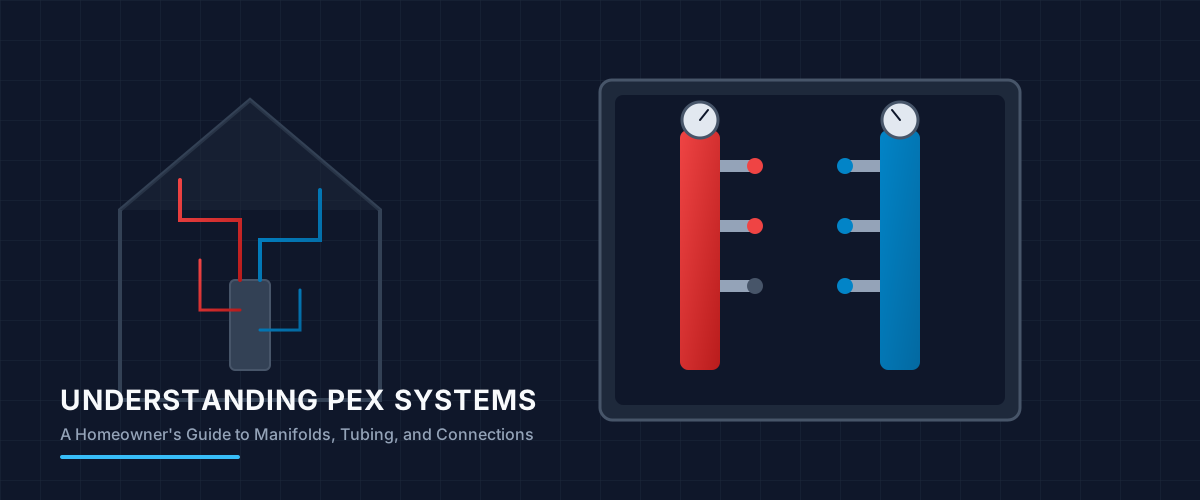
Whether you are buying a home in Cleveland, retrofitting an older property in Akron, or keeping an eye on your current home’s utility room in Canton, understanding your plumbing system is key to long-term property protection. Cross-linked polyethylene, universally known as PEX, has revolutionized modern residential plumbing. At the heart of most modern PEX systems sits the manifold—the “breaker panel” of your home’s water supply. Identifying these systems, understanding how they operate, and knowing what types of fittings hold them together is essential for preventing water damage, evaluating home purchases, and managing winter freeze risks in Northeast Ohio.
- Centralized Water Control: A PEX manifold allows you to isolate and shut off water to individual fixtures without losing service to the rest of the home.
- PEX Type Distinctions: Knowing the difference between PEX-A, PEX-B, and PEX-C determines the flexibility, freeze resistance, and repair methods of your piping.
- Fitting Integrity: Different fitting systems (crimp rings, pinch clamps, cold expansion, and push-fit) have varied lifespans and unique physical failure points.
- Ohio Winter Resilience: PEX is highly freeze-resistant compared to rigid copper or PVC, but the fittings themselves remain vulnerable to expansion damage if not installed correctly.
The Core Fundamentals: What is PEX?
PEX stands for cross-linked polyethylene. Through structural chemical modifications, high-density polyethylene molecules are linked together in a continuous, highly stable three-dimensional network. This cross-linking process changes the polymer from a thermoplastic to an elastomer, giving PEX its famous flexibility, shape memory, and temperature resistance.
However, not all PEX is manufactured the same way. The three primary methods of cross-linking yield different material properties, categorized as PEX-A, PEX-B, and PEX-C. Identifying which type is running through your joists is the first step toward understanding your home’s plumbing health.
PEX-A: The Flexible Standard
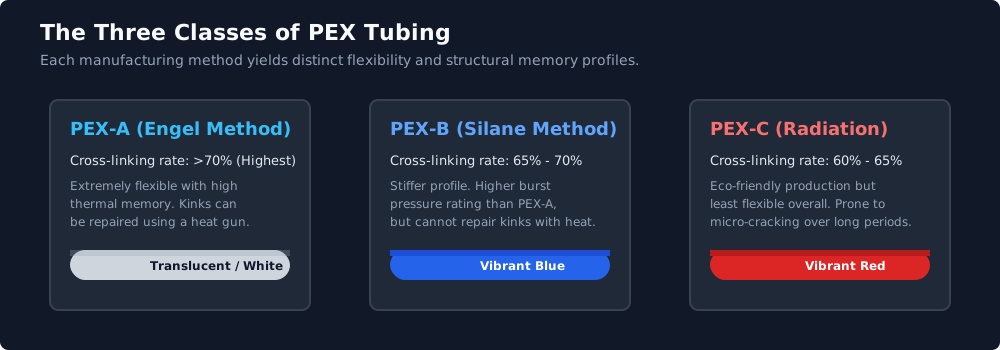
PEX-A is manufactured using the peroxide (Engel) method. This process performs cross-linking while the polyethylene is in a completely liquid state, resulting in the highest density of cross-links. What this means for your home is unparalleled flexibility. If a PEX-A pipe gets kinked during installation, a simple application of heat from a heat gun will activate its “thermal memory,” causing the pipe to return to its original shape without losing structural strength. PEX-A relies on cold-expansion fittings, which we will analyze further down.
PEX-B: Stiffness and Strength
PEX-B is created via the silane (or moisture-cure) process, where cross-linking occurs after extrusion by running the pipe through a hot water bath or steam room. This creates a slightly stiffer pipe. While it cannot be repaired with heat if kinked, PEX-B features higher resistance to chlorine degradation and exhibits higher raw burst pressure limits. It is the most commonly installed PEX type in DIY projects and mainstream residential builds due to its affordability and compatibility with standard crimp connections.
PEX-C: The Rigid Option
PEX-C is processed using electronic beam radiation. Because it is irradiated after extrusion, the cross-linking is sometimes less uniform than A or B. It is typically the stiffest PEX tubing, making it harder to maneuver around tight corners. Though still a viable material, it has fallen out of favor in high-end installations due to its lower resilience to cracking when bent too sharply.
The Central Nervous System: Identifying PEX Manifolds
A PEX manifold is a centralized distribution hub. Think of it as a circuit breaker panel, but for water. Traditional plumbing layouts use a “trunk-and-branch” configuration, where a single large pipe travels through the home, and smaller branch lines split off to feed individual sinks, showers, and toilets. A manifold system uses a “home-run” configuration: individual, continuous lines run directly from the central manifold block to every single fixture without any buried joints or connections in the walls.
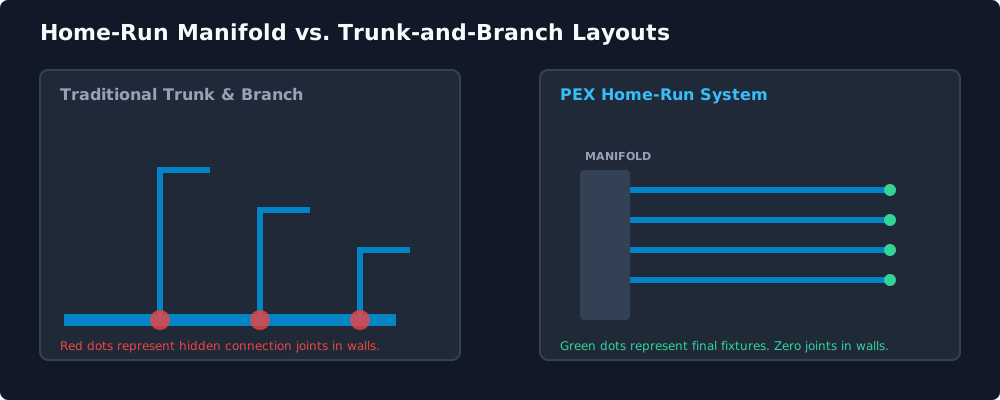
When walking through a prospective home’s basement, laundry room, or utility closet, you can easily identify a PEX manifold. It is typically a wall-mounted enclosure or open panel featuring two parallel metallic or plastic chambers (one hot, colored red or marked with red tags, and one cold, colored blue). A series of individual control valves protrude from each chamber, with colorful PEX lines branching off like spider legs to journey upward into the framing of the home.
The primary advantage of this system is safety and convenience. If your primary upstairs bathroom sink springs a leak, you don’t have to shut down water to the entire house. You simply walk to your manifold, identify the corresponding labeled valve, and twist it to isolate that individual sink. Furthermore, because there are no hidden tee-connections or couplings sealed inside structural drywall, the risk of a silent, slow leak rotting out your structural framing is drastically reduced.
How to Identify PEX Fittings and Connection Methods
While the PEX tubing itself is incredibly robust, the joints—specifically the fittings—are where physical dynamics, water chemistry, and installer error intersect. During my inspections across Northeast Ohio, I pay closest attention to how these lines are joined. There are four dominant connection standards in residential properties.
1. Copper Crimp Rings (ASTM F1807)
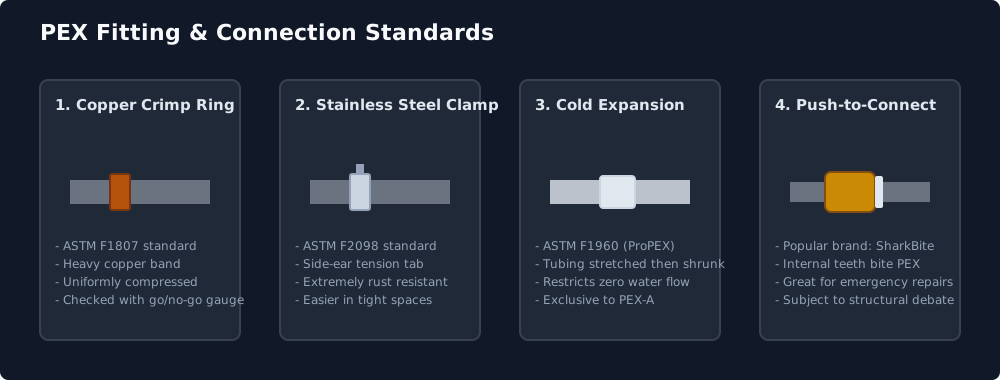
This is the veteran method of joining PEX-B tubing. The installer inserts a ribbed metal (brass or poly) fitting into the pipe, slides a black-colored copper ring over the assembly, and uses a heavy-duty manual crimping tool to crush the ring evenly around the connection. To verify a proper fit, a gauge (often called a “Go/No-Go Gauge”) is slipped over the ring. If the gauge slides on properly, the crimp is tight enough. If it fails to fit, the joint is under-crimped and will eventually leak.
2. Stainless Steel Pinch Clamps (ASTM F2098)
Often referred to simply as Oetiker clamps or pinch clamps, these bands feature a small raised section (the “ear”) that is mechanically squeezed together with a specialized ratcheting tool to tension the band around the pipe. They are made of high-grade stainless steel, offering outstanding resistance to corrosion—especially useful in damp, unconditioned Northeast Ohio crawlspaces and basements. They are highly favored by installers because the same tool handles multiple pipe diameters.
3. Cold Expansion Fittings (ASTM F1960)
This system is exclusive to PEX-A tubing. It utilizes the natural “shape memory” of the material. A matching PEX-A sleeve is slipped over the end of the pipe, and a specialized power tool expands the pipe and sleeve simultaneously. The installer quickly inserts a brass or plastic fitting, and within seconds, the PEX-A material shrinks back down to its original dimensions, creating a permanent, incredibly strong seal. Because the fitting has the same inner diameter as the pipe, this method does not restrict water flow rates like insert fittings do.
4. Push-to-Connect (SharkBite)
Most homeowners recognize these by the brand name SharkBite. Inside the brass body sits a ring of stainless steel grab teeth and a rubber O-ring. When the PEX pipe is pushed into the fitting, the teeth lock it in place while the O-ring seals the perimeter. No specialty crimping tools are required. While highly reliable for temporary repairs, most certified home inspectors caution against burying push-fit connectors inside closed walls, preferring mechanical crimping or expansion for permanent construction.
Home Inspection Red Flags: What We Look For in Northeast Ohio
Plumbing issues in Ohio are uniquely affected by cold winter drafts and old municipal water chemistry. When evaluating a plumbing system during a professional home inspection, we watch for several classic PEX installation mistakes.
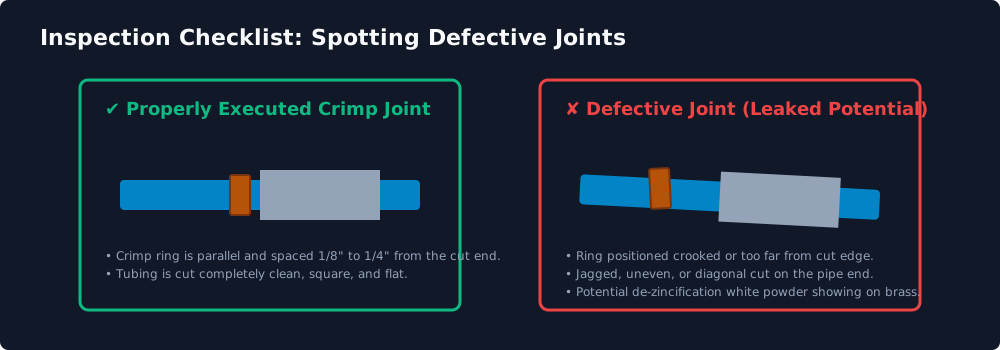
- Improper Crimp Placement: If a copper crimp ring is positioned too far back from the end of the tubing (further than 1/4 inch) or sits crookedly, it will fail to compress the internal sealing ribs uniformly. This can result in a delayed blowout leak down the line.
- Yellow Brass Corrosion (Dezincification): Early generations of PEX brass insert fittings (manufactured under certain ASTM standards) were made of cheap brass alloys containing high percentages of zinc. When exposed to highly oxygenated or acidic municipal water supplies, the zinc is chemically leached out of the alloy. This leaves behind a weak, porous copper framework covered in a white, chalky residue. This process, known as dezincification, eventually causes the fitting to snap or clog.
- Sharp Bend Kinks: PEX is highly flexible, but bending it beyond its rated minimum bending radius can lead to structural collapse. If a line is bent too sharply, it creates a stress concentration zone that will eventually crack under thermal cycling pressure. PEX-A can recover via heat-treatment; PEX-B lines must be cut out and spliced.
- Lack of Structural Support: PEX piping expands and contracts dynamically with temperature changes. If long horizontal runs are not supported by plastic hangers every 32 inches, the lines will sag, creating stress on the fittings. In contrast, metal hangers should never be used, as their sharp edges can saw through the plastic as the piping expands.
How do I know if my home has PEX-A or PEX-B?
The easiest way to tell is by looking at the markings printed directly on the side of the tubing. Manufacturers are required to print the standard ASTM specifications on the pipe every few feet. Look for the designation ASTM F1960 for PEX-A (expansion systems) or ASTM F1807 / F2098 for PEX-B (crimp and clamp systems). Alternatively, you can look at the physical connections: if you see black copper rings or steel ear clamps squeezed over the pipe, it is likely PEX-B. If you see a thick, colored plastic sleeve shrunk down over the fitting, it is PEX-A.
Can PEX freeze and burst in Northeast Ohio winter weather?
PEX is far more resilient to freezing temperatures than rigid materials like copper or CPVC. Because of its elastic molecular structure, PEX can expand significantly when water freezes inside it and then contract back to its original shape when thawed. However, while the tubing may survive a freeze, the metallic fittings (which do not expand) can crack or slide loose. In unconditioned basements, crawlspaces, and outer walls, PEX lines still require proper insulation and protection from cold air drafts.
Is it safe to mix and match different brands of PEX piping and fittings?
Generally speaking, yes, provided you strictly match the fitting design standards with the pipe type. For example, you can use any standard ASTM F1807 brass or poly crimp fitting inside any brand of PEX-B pipe. However, you must never use cold-expansion (F1960) fittings on PEX-B pipe, as PEX-B does not possess the structural elastic memory required to shrink back down and seal the fitting securely.
Buying or maintaining a home in the Cleveland, Akron, and Canton areas requires attention to detail—especially when it comes to systems hidden behind your walls. At Pinnacle Inspection Services, we use advanced thermographic technology and deep building science expertise to analyze your plumbing systems, looking for hidden corrosion, compromised fitting rings, and poor installation routing. Protect your investment before buying. If you need a comprehensive, highly visual home inspection, contact Jim Husseini at Pinnacle Inspection Services today to schedule your peace of mind.