

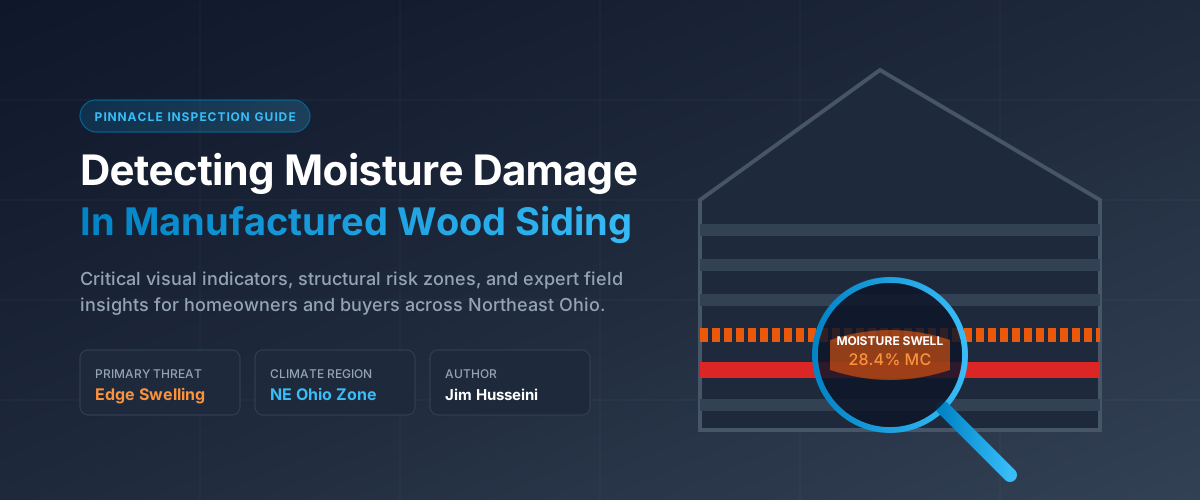
Manufactured wood siding—including hardboard, pressboard, composite, and engineered wood lap siding—has been installed on thousands of homes across Cleveland, Akron, Canton, and the surrounding Northeast Ohio communities over the last several decades. While modern engineered wood products like LP SmartSide perform remarkably well when installed and maintained correctly, older generations of pressboard and improperly sealed composite siding remain highly vulnerable to environmental moisture. Given our region’s brutal winter freeze-thaw cycles, lake-effect snow accumulation, and humid summer weather, early detection of moisture intrusion is essential to preventing catastrophic rot, interior mold, and structural decay.
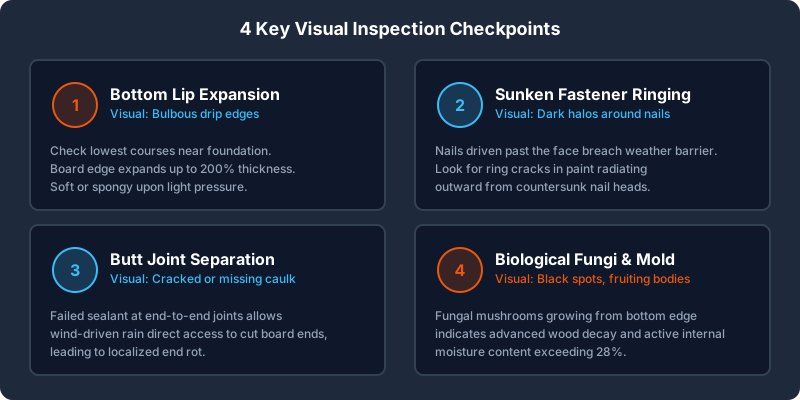
- Edge Swelling & Mushrooming: The bottom horizontal edge of manufactured siding is its weakest point; water absorption causes the material to expand up to twice its original thickness.
- Nail Head Countersinking: Nails driven too deep puncture the protective outer coating, creating direct conduits for rainwater to seep into the inner wood fiber core.
- Flashing & Joint Failures: Unsealed butt joints, missing Z-flashing, and insufficient clearance above rooflines trap standing water, accelerating structural core breakdown.
- Biological Indicators: Fungal growth, dark staining along bottom courses, and peeling paint are visual warnings that internal moisture content exceeds safe levels (over 19%).
Understanding Manufactured Wood Siding in Northeast Ohio
Manufactured wood siding is engineered by bonding wood fibers, strands, or sawdust together using synthetic resins, waxes, and heavy pressure. It is subsequently coated with a factory primer and painted. Unlike solid timber, which possesses natural grain boundaries, composite and hardboard sidings rely entirely on their outer paint film and water-resistive factory coatings to keep moisture out. Once that protective barrier is breached, the interior wood fibers act like a dense sponge.
In Northeast Ohio, our specific microclimate amplifies these material vulnerabilities. During winter, snowbanks pile against exterior walls, pushing wet snow directly against lower siding courses. As daytime temperatures rise above freezing and plunge back down at night, trapped water within the boards freezes, expands, and tears apart the internal resin bonds holding the wood fibers together. This process, known as delamination, leads to permanent structural softening.
Hardboard (Masonite) vs. Modern Engineered Wood
It is vital to distinguish between vintage hardboard siding (often produced between the 1970s and late 1990s under brand names like Masonite, Boise Cascade, or early LP Inner-Seal) and modern engineered wood siding. Vintage pressboard lacks modern zinc borate treatments and advanced hydrophobic resins. Modern engineered wood siding utilizes advanced wax coatings and cross-directional strength to resist moisture, but it remains susceptible to rot if installation details—such as edge sealing and clearances—are ignored during construction.

Primary Visual Indicators of Moisture Intrusion
When evaluating a home’s exterior, moisture damage rarely happens overnight. It leaves distinct visual clues before full structural collapse occurs. Recognizing these early warning signs can save homeowners thousands of dollars in widespread wall sheath reconstruction.
1. Bottom Edge Swelling and “Mushrooming”
The most frequent defect observed during our home inspections is swell along the bottom drip edge of lap siding boards. Factory siding is delivered with edge sealant, but field cuts made during installation frequently leave raw, exposed wood core material. As rainwater runs down the face of the board, it clings to the bottom lip. Capillary action draws water upward into the exposed fibers, causing the bottom edge to puff outward, resemblance to a mushroom profile. If the bottom edge of your lap siding measures significantly thicker than the top overlapped section, active moisture absorption is present.
2. Over-Driven Fasteners and Sunken Nail Heads
Pneumatic nail guns used during rapid construction can easily drive nail heads past the exterior surface, breaking through the factory primer and protective face layer. This creates a small cup around the nail head that holds rainwater. Over time, water seeps directly into the internal core surrounding the fastener, rusting the nail and causing localized bulging around the nail hole.
3. Paint Blistering, Peeling, and Flaking
When moisture accumulates inside a manufactured wood board, sun exposure heats the trapped water, turning it to vapor. This vapor pressure attempts to escape outward, pushing against the exterior paint layer. This results in localized bubbling, paint flaking, or long vertical peeling strips. Re-painting over blistered composite siding without resolving the core moisture issue will result in immediate paint failure within a single season.
4. Horizontal Board Buckling and Waving
Manufactured wood lap siding requires small expansion gaps (typically 3/16 inch) at butt joints and end terminations to accommodate thermal expansion. When boards become saturated with water, they expand lengthwise. Without adequate clearance, the boards press against one another, causing them to push outward from the wall frame, creating a distorted, wavy appearance along the exterior elevation.
Critical Vulnerability Zones Around the Home Exterior
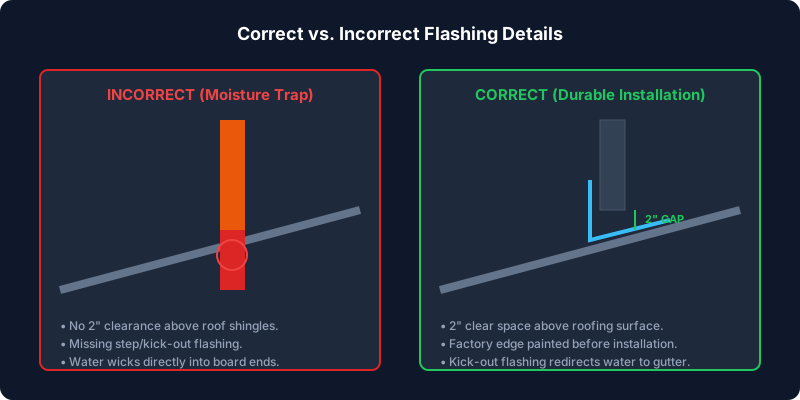
When performing a self-inspection or walking a prospective property with a professional home inspector, pay specialized attention to high-risk moisture zones. Manufactured siding rarely fails in the center of an uninterrupted wall; failure almost always originates at flashing intersections, rooflines, and ground clearances.
Roof-to-Wall Intersections and Kick-Out Flashings
Where a lower sloping roof terminates against a vertical siding wall, rainwater running down the roof edge must be directed into the gutter by a kick-out flashing. If the kick-out flashing is missing or improperly bent, hundreds of gallons of water per storm are channeled directly behind the siding. Furthermore, manufactured siding must maintain a 2-inch clearance above roof shingles. Siding installed flush against roofing material will continuously draw water up through capillary action.
Grade Clearances and Soil Contact
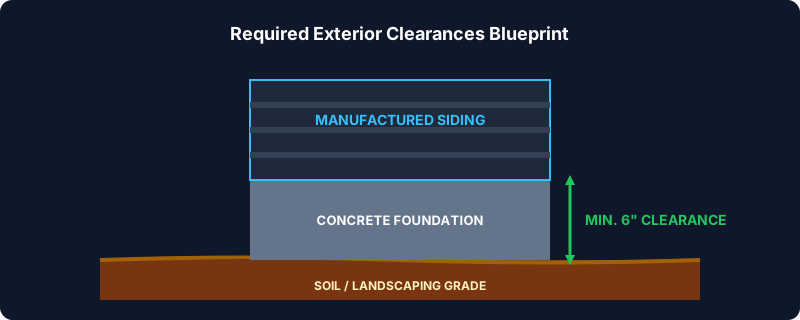
In accordance with standard building practices and manufacturer guidelines, composite wood siding must maintain a minimum distance of 6 inches from bare earth and 2 inches from hard surfaces like concrete patios, driveways, or walkways. Soil contact exposes the siding to constant ground moisture, subterranean termites, and rot organisms.
How Professional Inspectors Test Siding Integrity
Visual identification is only the first step in evaluating manufactured wood siding. During a comprehensive inspection, professional inspectors use specialized, non-destructive tools to measure internal moisture levels and assess structural soundness.
Pinless and Pin-Type Moisture Meters
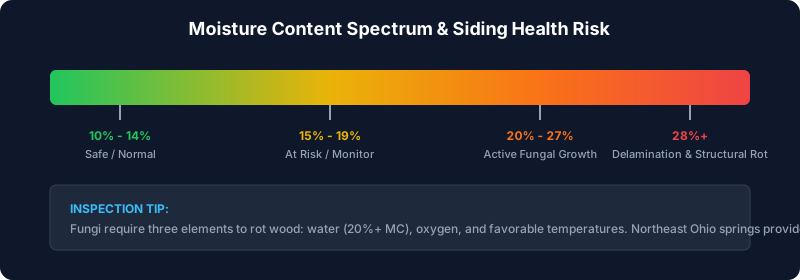
Professional home inspectors use specialized moisture meters calibrated for composite wood products. A pinless moisture meter uses radio-frequency signals to scan beneath the painted exterior layer without damaging the board surface. If elevated readings are detected, a fine dual-pin meter may be used to measure precise electrical resistance within the internal core wood fibers. Relative moisture scale interpretations:
- 8% to 14% Moisture Content: Normal outdoor dry conditions. Siding is stable.
- 15% to 19% Moisture Content: Elevated moisture zone. Borderline condition; requires paint re-sealing and monitoring.
- 20% and Above Moisture Content: Active decay risk. Fungi and wood-destroying organisms thrive at these levels. Board replacement is often required.
Maintenance and Preventive Measures for Homeowners
If your home currently features manufactured wood siding that is structurally sound, taking proactive maintenance steps can extend its lifespan for decades and prevent costly full-system tear-offs.
First, inspect butt joints and corner trim trim annualy. Replace missing or hardened, cracked caulking with high-grade, 100% polyurethane or elastomeric sealant designed specifically for exterior building joints. Avoid cheap acrylic caulk, which cracks quickly during Ohio freeze-thaw cycles.
Second, ensure proper paint coverage. If siding surfaces show chalking, fading, or minor micro-cracking, apply a premium 100% acrylic latex exterior paint. Prior to painting, verify that all exposed edges—especially trimmed bottom edges—are primed and sealed.
Third, manage your home’s landscaping and drainage. Trim back bushes and foliage at least 12 inches away from siding boards to promote ventilation and sunlight exposure. Keep gutters clean and ensure downspout extensions discharge water at least 5 feet away from foundation walls.
Can swollen manufactured wood siding be repaired by sanding and painting?
No. Once composite or hardboard siding absorbs water and swells, the internal resin bonds holding the wood fibers together are permanently broken. Sanding down a swollen bottom edge removes the protective outer layer and exposes bare wood fibers, accelerating future water absorption. Swollen or delaminated boards must be removed and replaced with properly flashed engineered wood or fiber-cement alternatives.
How can I tell if damaged siding has rotted the wall sheathing behind it?
Softness along lower siding courses, persistent musty odors indoors, or flexible, springy wall surfaces indicate that moisture has penetrated past the siding paper into the structural OSB or plywood wall sheathing. A certified home inspector can use pinless moisture meters or thermal imaging to detect moisture hidden behind the siding surface without destructive dismantling.
Is LP SmartSide vulnerable to the same rot issues as older Masonite siding?
Modern LP SmartSide uses advanced zinc borate and water-resistant resins, making it vastly superior to vintage Masonite pressboard. However, no wood product is immune to water damage if installed incorrectly. If LP SmartSide is installed without required grade clearances, with over-driven nails, or with unsealed field cuts, it can still absorb moisture and fail over extended periods.
Buying a home or concerned about the condition of your exterior siding? Contact Jim Husseini B.S., C.P.I., owner of Pinnacle Inspection Services, to schedule a comprehensive, unbiased home inspection in Northeast Ohio. Protect your investment with detailed diagnostic evaluations backed by industry expertise.