

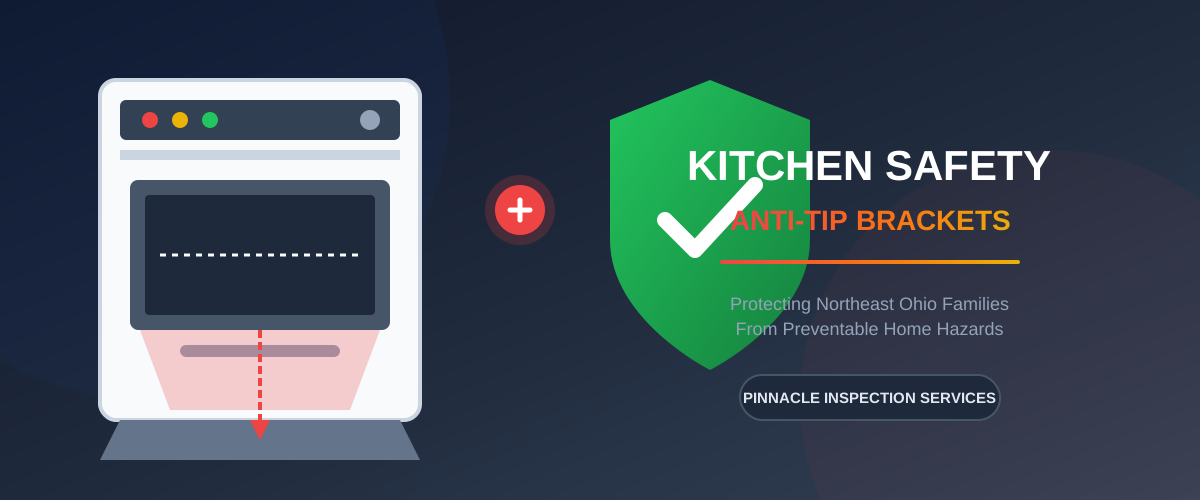
Welcome! I am Jim Husseini, B.S., C.P.I., owner of Pinnacle Inspection Services. Over my years inspecting thousands of homes throughout Northeast Ohio—from historic homes in Lakewood and Cleveland Heights to modern builds in Strongsville, Medina, and Mentor—I have consistently encountered one critical, life-saving component missing in kitchen after kitchen: the range anti-tip bracket. While a freestanding kitchen range seems heavy and inherently stable, its design creates a dangerous tipping hazard when the oven door is open. Installing an anti-tip bracket is an easy, inexpensive step that prevents severe injuries and costly home accidents.
- Critical Safety Device: Anti-tip brackets prevent free-standing ranges from tipping forward when downward force is applied to the open oven door.
- High Risk for Children: Young children often use an open oven door as a step to reach the stovetop, making them primary victims of range tip-over accidents.
- Widespread Non-Compliance: Despite being mandated by the National Electrical Code (NEC), International Residential Code (IRC), and manufacturer standards since 1991, anti-tip brackets are missing in over 60% of homes inspected.
- Simple Verification: Homeowners can safely test for the presence of a bracket within seconds using basic visual or manual checks.
- Low-Cost, High-Impact Fix: Installing a bracket costs very little in materials but yields invaluable peace of mind for your family.
Understanding the Threat: Why Kitchen Ranges Tip Over
A standard freestanding electric or gas range weighs anywhere between 150 and 300 pounds. Because of this substantial weight, many homeowners naturally assume the appliance is far too heavy to tip. However, physics tells a different story. The open door of an oven acts as a long lever arm. When downward weight is placed on the outer edge of that door, the center of gravity shifts dramatically forward, transforming the front leveling legs into a pivot point.
Consider these everyday scenarios that occur in Northeast Ohio kitchens:
- A curious toddler climbs onto the open oven door to reach a pan, batch of cookies, or boiling pot on the cooktop.
- A home chef places a heavy Thanksgiving turkey roasting pan onto the open door to baste it, inadvertently exceeding the tipping threshold.
- An adult loses balance or slips on a wet floor and catches themselves by pressing down firmly on the open oven door.
When a range tips forward, the consequences are disastrous. Beyond the risk of crush injuries from the falling appliance itself, a tipping range spills boiling liquids, hot grease, and hot food across the kitchen floor. If it is a gas range, tipping can rupture the flexible gas supply line, causing fuel leaks or fire hazards. For electric ranges, strained wiring can trigger electrical short circuits.

What Exactly Is an Anti-Tip Bracket?
An anti-tip bracket is a small, specialized metal safety device engineered to secure a free-standing range to the floor or rear wall. Designed to remain out of sight during daily kitchen activities, it engages automatically whenever the range is pushed into place.
The system operates on a remarkably simple mechanical principle: as the range slides back toward the wall, one of its rear leveling legs slides directly into the slotted channel of the heavy-gauge steel bracket. Once seated, the top lip of the bracket hooks over the foot or leg structure. If force is applied to the front of the range, attempting to tilt it forward, the bracket firmly captures the rear leg, locking the entire unit to the structural floor joists or wall studs.

Why Are Anti-Tip Brackets So Frequently Missing in Ohio Homes?
Since 1991, major safety standards organizations, including Underwriters Laboratories (UL) and the American National Standards Institute (ANSI), have mandated that all freestanding residential ranges include anti-tip brackets. Additionally, building codes enforced throughout Ohio mandate their installation. Despite this clear standard, during home inspections across Cleveland, Akron, and Canton, I find that missing brackets are the rule rather than the exception.
Why is this hazard so widespread? There are several main factors:
1. DIY and Retail Appliance Delivery Installations
When purchasing a new range from a major home improvement retailer, third-party delivery teams are often compensated based on speed. Installing the bracket requires measuring, pulling out tools, drilling into floor or wall materials, and locating structural studs. As a result, installation crews frequently leave the bracket in its plastic bag taped to the back of the appliance or toss it in a drawer altogether.
2. Kitchen Flooring Renovations
Homeowners frequently update kitchen flooring—installing luxury vinyl plank (LVP), ceramic tile, or hardwood over original subfloors. During flooring updates, contractors remove the range and the old anti-tip bracket. Once the new flooring is laid down, installer crews often fail to re-install the bracket at the adjusted floor height.
3. Older Northeast Ohio Housing Stock
Northeast Ohio boasts historic homes, particularly in communities like Cleveland Heights, Shaker Heights, and Lakewood. Many of these homes feature plaster walls over masonry or original plank subfloors. Installers who lack masonry bits or heavy-duty fasteners often skip bracket installation on these challenging substrates.

How to Check If Your Range Is Secure: A Simple Step-by-Step Guide
Testing for a missing anti-tip bracket is straightforward and requires no special tools. Every homeowner should perform this quick safety verification.
Method 1: The Visual Inspection (Safe & Simple)
Empty the bottom warming drawer or storage drawer under your oven and remove it completely. Shine a flashlight toward the floor at the back corners of the range. You should see a metal bracket firmly anchored to the floor or wall, with one of the rear leveling feet securely slotted underneath it.
Method 2: The Physical Tilt Test (Proceed with Caution)
If your range does not have a removable bottom drawer, perform a careful physical test:
- Ensure the range is completely cool, and all cooktop burners are turned off.
- Clear off all cookware, pans, and glass items from the top of the stove.
- Grasp the upper rear border or sides of the range frame firmly.
- Gently pull forward and upward.
What to look for: If an anti-tip bracket is installed correctly, the unit will move forward less than an inch before stopping firmly. If the entire rear of the range lifts easily off the floor, an anti-tip bracket is missing or improperly engaged.

Installation Options: Floor vs. Wall Mounts
Anti-tip brackets offer flexible mounting options depending on your kitchen’s structural layout and flooring materials.
- Floor-Mounted Installation: Preferred for wood subfloors. Heavy-duty screws fasten the bracket directly through floor coverings into wood joists or subflooring.
- Wall-Mounted Installation: Ideal when installing over delicate flooring surfaces like custom ceramic tile, natural stone, or radiant heating loops. The bracket mounts directly to wall studs at the base of the rear wall.
- Concrete Substrates: For slab-on-grade foundations or basement installations, masonry anchors or expansion bolts are used to anchor the bracket into concrete.
Universal anti-tip bracket kits are readily available at any local home improvement store in Northeast Ohio for $10 to $20. Installation generally takes about 20 to 30 minutes, making it one of the most cost-effective safety upgrades for your home.
Do all ranges require an anti-tip bracket?
Yes. All free-standing residential ranges manufactured after 1991 require an anti-tip bracket under national building codes and safety standards (UL/ANSI). This requirement applies regardless of whether the range is gas or electric, heavy or lightweight.
Will installing an anti-tip bracket damage my kitchen flooring?
Not if installed correctly. While floor-mounted brackets require drilling pilot holes into subflooring, wall-mounted brackets can be anchored directly into wall studs behind the range. This alternative eliminates the need to drill into decorative tile, hardwood, or heated flooring systems.
What should I do if my Pinnacle home inspection reveals a missing anti-tip bracket?
If your inspection report flags a missing anti-tip bracket, there is no need to worry. You can request that the seller have a qualified professional install one prior to closing, or you can pick up a universal bracket kit at a local hardware store and install it yourself before moving in.
Protecting What Matters Most in Northeast Ohio
As a certified professional inspector, my priority is ensuring that your home is both a sound investment and a safe environment for your family. Identifying subtle safety hazards—like missing anti-tip brackets, ungrounded outlets, or hidden moisture issues—is at the core of what we do at Pinnacle Inspection Services.
Whether you are purchasing a home in Cleveland, scheduling a pre-listing inspection, or looking to ensure your current home is completely safe, trust Pinnacle Inspection Services for thorough, accurate, and professional evaluation. Contact us today to schedule your comprehensive home inspection!