
Living in Northeast Ohio means enjoying beautiful seasons, but it also means dealing with high humidity, rapid temperature changes, and plenty of precipitation. From the melting snows of a Summit County winter to the humid afternoons of a Cuyahoga summer, our local climate creates the perfect breeding ground for mold.
Many homeowners assume that if they can’t see mold, it isn’t there. However, getting your home tested is one of the most proactive steps you can take for your long-term health and property value.
You Can’t Always See the Problem
One of the biggest misconceptions about indoor air quality is that mold is always visible. The reality is that dangerous mold colonies often thrive in places you cannot see—behind drywall, under flooring, or inside HVAC ductwork.
According to the Environmental Protection Agency (EPA), mold can begin growing within 24 to 48 hours of water exposure, often remaining undetected until a musty odor appears or health issues arise [1]. By the time you smell it, the spore count in your air may already be significantly elevated compared to the outdoor baseline.
Mold Affects Everyone Differently
Have you ever wondered why one person in the house feels sick while another feels fine? Mold affects individuals differently based on their immune system, age, and existing respiratory conditions.
The Centers for Disease Control and Prevention (CDC) notes that while some people may have no reaction, others may experience nasal stuffiness, throat irritation, coughing, or eye irritation. For those with mold allergies or asthma, the reaction can be severe [2]. The Mayo Clinic emphasizes that there is no “safe” level of mold for everyone; what is harmless to a healthy adult might trigger a serious reaction in a child or someone with a compromised immune system [3].
This variability is exactly why testing is crucial. Without scientific data, you are guessing about the cause of your family’s symptoms.
Professional Testing: Fast, Easy, and Trusted
The good news is that identifying the problem is not difficult or invasive. Professional mold testing has evolved into a precise science.
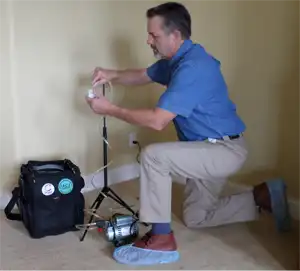
- It is Easy: We use non-invasive air pumps to capture microscopic spores from the air in your home. No tearing down walls is required for the initial inspection.
- It is Fast: We understand that waiting is stressful. Modern lab analysis allows us to provide results as quickly as the next business day.
- It is Trusted: Professional inspectors follow protocols set by organizations like the International Association of Certified Indoor Air Consultants (IAC2). We rely on biology and physiology—not guesswork—to analyze the samples [4].
Peace of Mind for Ohio Homeowners
Whether you are buying a new home in Cleveland or suspect your current home in Akron has an issue, knowledge is power. The World Health Organization (WHO) has established that indoor dampness and mold are associated with a significant increase in respiratory infections and asthma [5]. Testing gives you a definitive “Yes” or “No” so you can either rest easy or take the necessary steps to remediate the issue.
Don’t wait for visible spots to appear. If you suspect an issue, let science provide the answer.
Bibliography
- United States Environmental Protection Agency (EPA). (2023). A Brief Guide to Mold, Moisture, and Your Home. Washington, D.C.: Office of Air and Radiation. Retrieved from epa.gov/mold
- Centers for Disease Control and Prevention (CDC). (2022). Basic Facts about Mold and Dampness. Atlanta, GA: National Center for Environmental Health. Retrieved from cdc.gov/mold
- Mayo Clinic. (2023). Mold Allergy: Symptoms & Causes. Rochester, MN. Retrieved from mayoclinic.org
- International Association of Certified Indoor Air Consultants (IAC2). (2023). IAC2 Standards of Practice for Mold Inspections. Boulder, CO. Retrieved from iac2.org
- World Health Organization (WHO). (2009). WHO Guidelines for Indoor Air Quality: Dampness and Mould. Copenhagen: WHO Regional Office for Europe. Retrieved from who.int
Frequently Asked Questions About Mold in Ohio
Why is mold so common in Northeast Ohio? Northeast Ohio has a specific climate with high humidity in summer and rapid freeze-thaw cycles in winter. These temperature fluctuations often cause condensation and moisture buildup in basements and attics, creating ideal conditions for mold growth.
Can mold make me sick even if I don’t see it? Yes. Microscopic mold spores can float through the air and be inhaled, causing respiratory issues, allergies, and other health problems. The Center for Disease Control (CDC) notes that mold can affect people differently, even if there is no visible growth on the walls.
How accurate is professional mold testing? Professional testing is highly accurate because it uses scientific air pumps to capture a precise volume of air. This allows laboratory biologists to count the exact number of spores per cubic meter and compare it to an outdoor control sample, providing a definitive scientific assessment.